Spaced repetition explained
Spaced repetition is a study method that brings a fact back just before you would have forgotten it, then waits longer each time you get it right. A scheduler holds every item separately, gives each one its own next review date, pushes that date further out after a success, and pulls it in close after a failure.
Two findings hold it up. Memory for something you studied once fades along a curve steep enough that the timing of a review is not arbitrary. And the same total study minutes spread across several days produce better retention than the same minutes packed into one sitting, which is the spacing effect. Put those together and you get software that decides, word by word, whether today is the day. For language learners the item is usually a vocabulary word, and the practical payoff is that you stop rereading the words you already own.
Every word gets its own clock. Answer correctly and the clock runs longer. Answer wrong and it resets. You are not studying a list, you are servicing a few hundred separate timers, and the app is the thing keeping track.
Where the spacing effect comes from
Hermann Ebbinghaus, working in Germany in the 1880s, memorized long lists of nonsense syllables and then tested how much he could relearn after gaps ranging from twenty minutes to a month. The result, published in 1885, is the curve everyone has seen: a steep early drop, then a long shallow tail (Ebbinghaus, 1885, translated 1913).
Worth saying plainly, because most articles skip it: Ebbinghaus was his own and only subject. He designed the experiments, ran them on himself for years, and reported his own retention. By modern standards that is a case study rather than an estimate of how people in general forget. The reason the shape survived is that other people checked it. Jaap Murre and Joeri Dros re-ran his procedure with a new subject and a different language and got a curve very close to his (Murre and Dros, 2015).
What Ebbinghaus never gave anyone was a schedule. Knowing that memory decays does not tell you when to come back. That question was settled much later and by pooling, not by one experiment. Nicholas Cepeda and colleagues gathered 839 assessments of distributed practice from 317 experiments across 184 articles, and found not only that spaced study beat massed study, but that the gap producing the best retention grew as the delay before the test grew (Cepeda and colleagues, 2006). Remember something for a week and short gaps are fine. Remember it for a year and the gaps have to widen.
How an SM-2 scheduler decides your next review
The scheduling logic in almost every flashcard app alive traces back to one Polish student. Piotr Wozniak, then studying molecular biology in Poznan, ran timing experiments on his own memory and started using a paper version of his method on August 25, 1985. Two years later he wrote it as software in Turbo Pascal and began using SuperMemo 1.0 for DOS on December 13, 1987 (History of SuperMemo). The refined version that shipped in SuperMemo 2 was published as Algorithm SM-2, and that is the name you still see in app changelogs almost forty years later.
SM-2 keeps three numbers per item: how many days until the next review, an ease factor describing how easy that item has proven to be, and a count of consecutive successes. The published rules are compact. The first successful review schedules the item one day out. The second schedules it six days out. Every one after that multiplies the previous interval by the ease factor. The ease factor starts at 2.5, moves up or down with the grade you give yourself, and never falls below 1.3. A grade below the passing threshold sends the item back to the start of the ladder (Wozniak, 1990).
Follow one easy word through that and you get 1 day, 6 days, 15 days, 38 days, 94 days. Five correct answers spread over three months and the word is effectively yours. A word you keep missing never leaves the bottom of the ladder, which is the point: your attention gets pulled toward it automatically, without you having to notice.
Modern implementations tune the constants. Lingotify starts at one day, uses three days for the second interval rather than six, and multiplies by ease after that. A miss on a word you have held for weeks halves the interval instead of zeroing it, so a single bad morning does not erase two months of work. Ease is clamped between 1.3 and 2.5 on the server, and a word that has lapsed eight times gets flagged as one you probably need a different approach for.
Why cramming feels better and works worse
During a cram session the answer is still warm from four minutes ago. Recall is instant, nothing hurts, and that smoothness reads as knowledge. It is mostly the item sitting in short-term memory, which is a place things do not stay.
Spacing gives you the opposite sensation. By the time a word comes back you have half lost it, retrieval takes visible effort, and you feel worse at the language than you did during the cram. The Cepeda synthesis is the reason to distrust that feeling. On any test worth caring about, meaning one delayed past the study session, the spaced schedule wins, and the longer the delay you care about, the wider the gaps should have been.
Cramming is not always wrong. For an exam tomorrow morning it is the rational play, because tomorrow morning is inside the window where massed practice still holds. For speaking a language in a year it is a waste of the same hours. We went through the mechanics of this tradeoff in how to memorize vocabulary fast, including why testing yourself beats rereading even when rereading feels more productive.
What a real week of reviews looks like
The tidy diagrams make this look smooth. It is not. Here is a realistic first week after you add twelve new words on a Monday.
- Monday. Twelve new words, all scheduled for tomorrow. Twelve cards.
- Tuesday. All twelve return. Nine come back cleanly and jump to Friday. Three fail and reset to tomorrow.
- Wednesday. Only those three, plus whatever older words happen to fall due. Four cards, maybe six.
- Thursday. Possibly nothing at all. This is normal and not a sign the system is broken.
- Friday. The nine from Tuesday arrive together. One of them has quietly gone, and resets.
- Weekend. The strays, plus the first words from last month coming round on their long intervals.
The daily count is lumpy, which surprises people who expect a flat twenty minutes. Over a longer horizon the shape reverses: a word you keep answering correctly might show up five times in its first month and twice in the following six. The queue you are afraid of is front-loaded, and it thins.
The other thing nobody warns you about is the backlog. Skip four days and you return to every interval that expired while you were gone, all at once. Most people quit here. The fix is unglamorous, which is to cap the daily new words low enough that a missed week is survivable.
How Lingotify runs spaced repetition
Every word you save carries its own SM-2 state on the server: interval, ease factor, lapse count, and a mastery level that moves from new to learning to mastered to reinforced, with a struggling branch for the ones that keep falling over. Nothing about that is unusual. What is unusual is where the reviews show up.
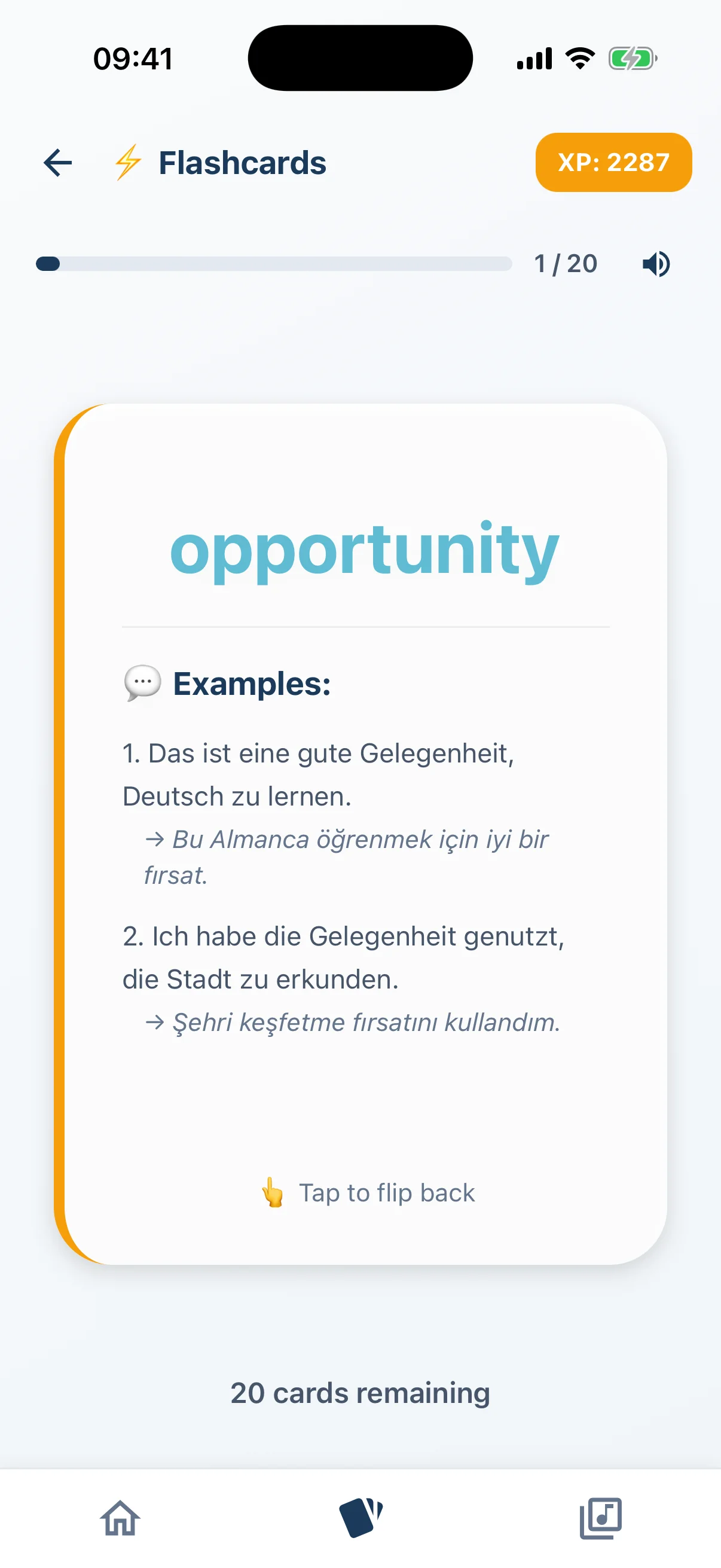
The first place is the flashcard deck, which works the way you would expect. A card, a flip, and four grades. The interval printed on each button is the real one your answer will write, computed by the same function that saves it, so you can see what saying Easy actually costs you before you say it.
The second place is the music. Lingotify generates a song from the words you chose, so a track built out of your own failing vocabulary is itself a review you happen to enjoy. Karaoke highlights each word as it is sung. In-song quizzes blank a word out of the line you just heard and ask you to fill it, and every one of those answers writes to the same SM-2 schedule the flashcards write to. There is no second, parallel notion of progress. Why the melody helps at all is a separate question, and we covered the evidence in why music makes vocabulary stick.
The Hook preset is where the two systems meet. It reads your review history, takes the words your SRS state says are weakest, and builds the chorus around them so those words repeat at least four times in one track. Wanda Wallace found that text sung to the same melody across verses was recalled better than spoken text, while a new melody each time did worse than speech, so repetition is the half doing the work. The chorus is where the words you keep missing belong.
Build a song from your weakest words
If flashcard apps have already burned you once, the honest comparison is in our Anki alternative for people who hate flashcards. If you want the scheduling applied to a specific language, start with learning Spanish with songs or the evidence on whether songs help at all. And if you have ever wondered why a chorus refuses to leave your head, that has a research answer too.
Frequently asked questions
How long should the gaps between reviews be?
Long enough that recall takes effort, short enough that you still get there. The Cepeda synthesis found the best gap scales with how long you need to hold the material, so there is no single correct number. In practice you do not pick it. An SM-2 style scheduler starts at a day, moves to three or six, then multiplies by an ease factor it adjusts from your own answers, which converges on the right spacing for that specific word far more reliably than intuition does.
Does spaced repetition work for grammar and phrases, or only single words?
It works for anything you can turn into a question with a definite answer, which includes verb conjugations, fixed phrases, idioms and gendered articles. What it cannot do is teach you a rule you have never had explained. Spaced repetition is a retention system, not an instruction system. Learn the pattern somewhere else, then use scheduling to stop it fading.
How many minutes a day does spaced repetition take?
Ten to fifteen minutes for a moderate load, but the number swings day to day because reviews arrive in clumps rather than evenly. The variable that actually controls your time is how many new words you add, since every new word generates roughly five reviews in its first month. Adding twenty a day and adding five a day produce completely different Novembers.
Sources
- Ebbinghaus, H. (1885). Über das Gedächtnis. Translated by H. A. Ruger and C. E. Bussenius (1913) as Memory: A Contribution to Experimental Psychology. psychclassics.yorku.ca/Ebbinghaus/memory1.htm
- Murre, J. M. J., and Dros, J. (2015). Replication and analysis of Ebbinghaus' forgetting curve. PLOS ONE, 10(7), e0120644. doi.org/10.1371/journal.pone.0120644
- Cepeda, N. J., Pashler, H., Vul, E., Wixted, J. T., and Rohrer, D. (2006). Distributed practice in verbal recall tasks: A review and quantitative synthesis. Psychological Bulletin, 132(3), 354 to 380. doi.org/10.1037/0033-2909.132.3.354
- Wozniak, P. A. (1990). Application of a computer to improve the results obtained in working with the SuperMemo method. supermemo.com/en/archives1990-2015/english/ol/sm2
- History of SuperMemo. SuperMemo Guru. supermemo.guru/wiki/History_of_SuperMemo
- Wallace, W. T. (1994). Memory for music: Effect of melody on recall of text. Journal of Experimental Psychology: Learning, Memory, and Cognition, 20(6), 1471 to 1485. doi.org/10.1037/0278-7393.20.6.1471