Do songs help you learn a language?
Yes, under conditions most articles on this topic skip. Songs have measurable effects on vocabulary, fixed phrases and pronunciation. They do close to nothing for grammar nobody has explained to you, and one carefully run experiment found that singing made recall worse.
The evidence, compressed. Adults learning unfamiliar Hungarian phrases by singing them beat adults who spoke the same phrases, and the gap showed up on tests that made them produce the phrases out loud (Ludke, Ferreira and Overy, 2014). Sung text is recalled better than spoken text, but only when the same melody comes back across verses (Wallace, 1994). Ecuadorian children who learned an English passage as a song beat a spoken-poem group on recall, vowel pronunciation and translation, and the advantage held six months later (Good, Russo and Sullivan, 2015). Pulling the other way, French speakers memorizing lines from unfamiliar French folk songs recalled fewer words when singing than when speaking (Racette and Peretz, 2007). The reading that fits all four is narrower than the usual claim: songs help when the words are new to you, when the tune repeats, and when you produce the language instead of absorbing it.
Songs earn their place on vocabulary, phrases and pronunciation in a language you do not know yet. They are a poor tool for grammar, formal register and unscripted conversation. And the melody has to repeat.
What does the strongest singing versus speaking study show?
The cleanest experiment comes from Karen Ludke, Fernanda Ferreira and Katie Overy in Memory & Cognition. Sixty adults were randomly assigned to three listen-and-repeat conditions for phrases in Hungarian, a language none of them knew: speaking, rhythmic speaking, or singing. After fifteen minutes the singing group performed better overall, significantly so on the two tests that made participants recall and produce spoken Hungarian. Age, gender, mood, phonological working memory and musical training did not account for the gap.
The design detail I find most persuasive is the middle condition. Rhythmic speaking was tested on its own, so the singing advantage cannot be written off as rhythm doing all the work.
The limits matter as much, and popular summaries drop them. Sixty participants, one language pair, one fifteen minute session. A real effect on a narrow task, not evidence of fluency.
Why did one experiment find that singing hurt recall?
Because changing the task flips the result, which is the part of this literature that usually goes missing.
Amélie Racette and Isabelle Peretz had native French speakers learn lines from unfamiliar French folk songs, presented either sung a cappella or spoken. Their paper opens by offering evidence against the common belief that learning verbal material through song aids word recall. Fewer words were recalled when participants sang their answers than when they spoke them, and presentation mode made no significant difference. Text and melody, the authors concluded, are stored separately, so singing during learning behaves like a dual task.
Notice what changed between the two studies. Racette's participants already knew every word, because it was their own language. Ludke's knew none. When the vocabulary is already yours, melody adds processing load and buys nothing. When it is new, that same structure hands you chunking and stress placement. That reconciliation is my reading of two papers, not something either demonstrates.
Does the melody itself matter, or just the repetition?
Both, and Wanda Wallace's experiments show how they interact. People who heard three verses of a text sung to the same melody recalled it better than people who heard it spoken. People who heard one sung verse, or a different melody each time, did worse than the spoken group (Wallace, 1994).
The consequence is blunt. A melody you have not learned yet is not a memory aid, it is more material competing for attention. Once the tune is familiar it starts working, cutting the line into chunks and marking where the stress falls. A plausible mechanism is dual coding, the claim that material held in both a verbal and a non-verbal system has more routes back to it (Paivio, 1991), though Paivio studied visual imagery rather than melody.
Operationally: put your hardest words in the chorus and keep one tune per batch. More on the memory side in why music makes vocabulary stick, and on involuntary replay in why songs get stuck in your head.
Put your own words in a chorus
Can songs improve your pronunciation?
Arla Good, Frank Russo and Jennifer Sullivan had Spanish-speaking Ecuadorian children learn a novel English passage over two weeks, one group as a song and the other as a spoken poem. They were tested on verbatim recall, production of English vowel sounds, and translating target terms into Spanish. The sung group outperformed the spoken group on all three, and the advantage was still present after a six-month delay.
Two cautions. These were children, one passage, one language pair. The authors note that singing tends to be more motivating than reciting, so some of the effect could be engagement rather than melody. When an advantage survives six months, though, why it works matters less than that it kept working.
The pronunciation result was on vowels specifically. A sung line gives you a slowed, repeatable model of a vowel with a beat telling you how long to hold it. A phonetics chart does not.
What do songs not do?
Music strengthens a memory and repeats a memory. It does not schedule one, and scheduling is where long-term retention gets decided. The largest synthesis on distributed practice covers 839 assessments across 317 experiments in 184 articles, and found that the interval producing best retention grows as the retention interval grows (Cepeda, Pashler, Vul, Wixted and Rohrer, 2006). Ten plays tonight is not ten plays spread over two months.
Three further limits. Songs teach a phrase in one grammatical shape, so knowing the chorus is not being able to reshape the sentence. Recognizing a word the music hands you is much easier than producing it cold, and conversation only asks for the second. Lyrics also skew informal, a poor route to the register an email to a landlord needs.
The failure mode I see most often is treating a playlist as a curriculum. Listening feels productive because it is pleasant, and pleasantness is a weak signal of learning.
How should you actually use songs?
- Sing, or at least mouth the words. Both studies with the largest effects had participants producing the language.
- Repeat the tune, not the novelty. One song learned properly beats twelve played once.
- Load the chorus. The most repeated section is where your worst vocabulary belongs.
- Read while you listen. Word by word text stops you learning a confident mishearing.
- Test yourself without the music. If a word only arrives when the melody plays, it is not learned yet.
- Space the reviews. Widening intervals across weeks, not one evening of replays.
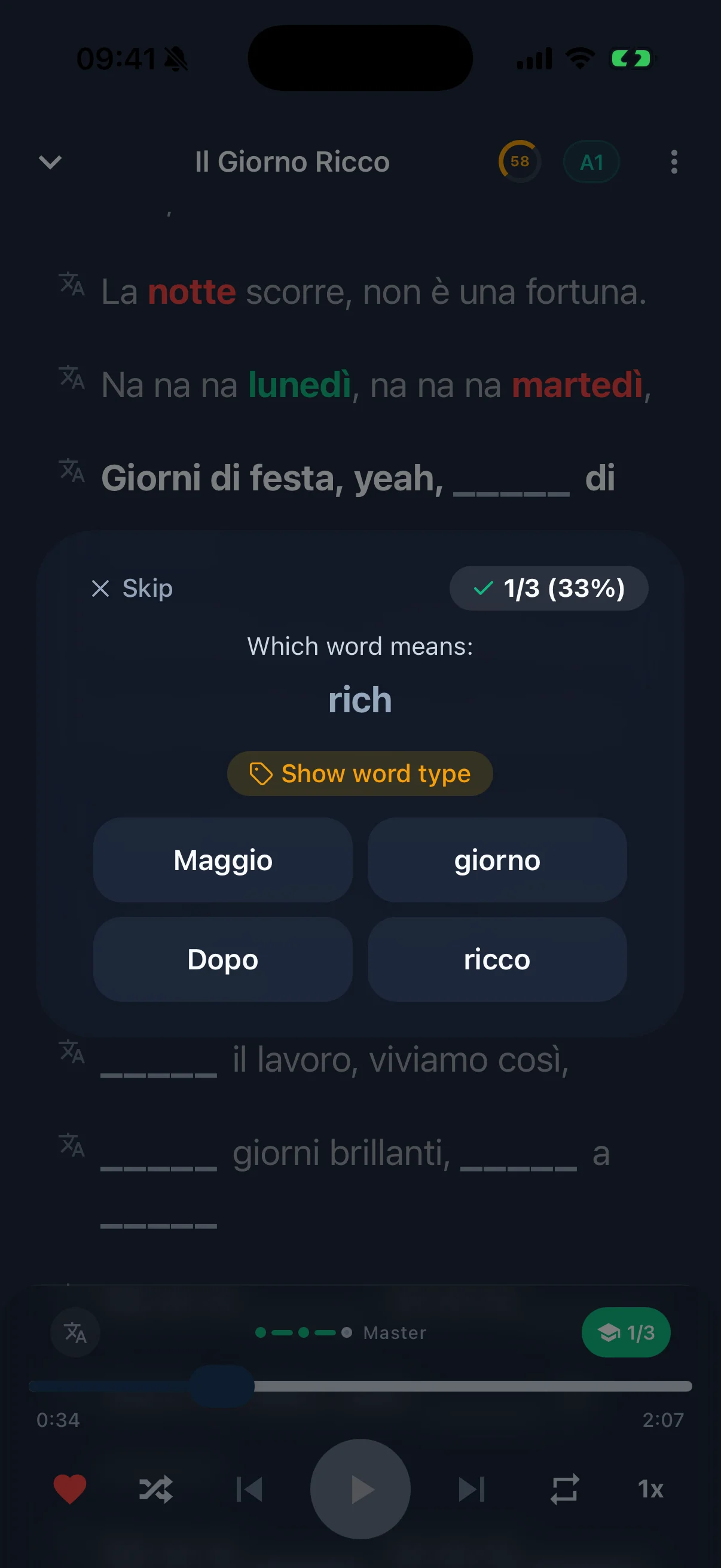
Lingotify is built against these findings. You pick the words and the song is generated around them, so the lines that repeat are vocabulary you actually failed. The Hook preset builds the chorus from the words your review history says are weakest. Karaoke highlights each word as it is sung, in-song quizzes blank a word out of the line you just heard, and every answer feeds an SM-2 spaced repetition schedule.
The Discover library is free to listen to and your first song is a gift; after that the free tier is two custom songs a month, plus up to two more for watching a rewarded video. Premium is $5.99 a month with a seven day trial. More in our guides to learning German with music and learning Spanish with songs.
Frequently asked questions
Do songs help you learn a language faster than flashcards?
No study has run songs against flashcards over months, so any speed multiplier you see quoted was invented. What the research supports is narrower: singing beat speaking on production tests in a fifteen minute experiment, and a sung passage beat a spoken one in children after two weeks. Flashcards still do the one thing songs cannot, which is deciding when a word comes back.
Does it work if you only listen and never sing along?
Partly. The conditions that produced the clearest advantages had participants producing the language, singing the phrases in the Ludke experiment and learning a passage as a song in the Good experiment. Listening alone still gives you exposure and a pronunciation model. But recognizing a word the music hands you is the easy direction, and conversation asks for the hard one.
Should I use real music or songs made from my own words?
Both, for different jobs. Authentic music gives you natural speech, culture and slang no generated track will match. It is simply not targeted, because the words you keep failing are unlikely to appear in the chorus of a chart hit. A song built from your own failed vocabulary puts them in the repeated section, where Wallace's result says the benefit lives.
Sources
- Ludke, K. M., Ferreira, F., and Overy, K. (2014). Singing can facilitate foreign language learning. Memory & Cognition, 42(1), 41 to 52. doi.org/10.3758/s13421-013-0342-5
- Racette, A., and Peretz, I. (2007). Learning lyrics: To sing or not to sing? Memory & Cognition, 35(2), 242 to 253. pubmed.ncbi.nlm.nih.gov/17645165
- Wallace, W. T. (1994). Memory for music: Effect of melody on recall of text. Journal of Experimental Psychology: Learning, Memory, and Cognition, 20(6), 1471 to 1485. doi.org/10.1037/0278-7393.20.6.1471
- Good, A. J., Russo, F. A., and Sullivan, J. (2015). The efficacy of singing in foreign-language learning. Psychology of Music, 43(5), 627 to 640. doi.org/10.1177/0305735614528833
- Paivio, A. (1991). Dual coding theory: Retrospect and current status. Canadian Journal of Psychology, 45(3), 255 to 287. doi.org/10.1037/h0084295
- Cepeda, N. J., Pashler, H., Vul, E., Wixted, J. T., and Rohrer, D. (2006). Distributed practice in verbal recall tasks: A review and quantitative synthesis. Psychological Bulletin, 132(3), 354 to 380. doi.org/10.1037/0033-2909.132.3.354