Learn Spanish with songs, and actually keep the words
Yes, you can learn Spanish with songs, and for two specific jobs music beats almost every other method: making vocabulary stay put, and speeding your ear up enough to follow real speech. What it will not do is work by osmosis. Reggaeton playing in the background while you cook teaches you close to nothing.
Here is the method that works, in four moves:
- Choose the words first. Five to ten words you actually want, not whatever a hit song happens to contain.
- Put them in a chorus you will replay. Repetition wrapped in melody is the thing music is uniquely good at.
- Read while you listen, word by word. Sound and meaning have to land in the same second, or you are just enjoying a tune.
- Answer questions about those words across several days. Not once, and not all in one sitting.
Move four is the one everybody skips, and it is the one the evidence is most certain about. Music gets a word into your head fast. Spaced retrieval is what keeps it there. Do both and Spanish songs stop being pleasant background noise and start being a vocabulary engine. The rest of this guide covers why Spanish in particular sits so well on a beat, what the research does and does not support, and how to run the whole loop in one week.
Why does Spanish fit music better than most languages?
Spanish and song share a pulse. Linguists sort languages into rhythm classes, and the measurements back the intuition: Ramus, Nespor and Mehler recorded eight languages, including Spanish and English, and found that the proportion of the signal taken up by vowels plus the regularity of those vowels sorted the languages into the groups linguists had long proposed (Cognition, 1999). Spanish lands in the corner with a high vowel share and low variability in its consonant intervals. English lands in the opposite corner: fewer vowels by duration, much lumpier consonants.
In plain terms, Spanish syllables get shared out more evenly, while English squashes the unstressed ones into mush. That matters for singing, because a melody imposes an even grid whether the language likes it or not. English lyrics fight that grid, which is why a sung English line and a spoken English line can sound like different languages. Spanish lyrics mostly go along with it. The version you memorise from a song is much closer to the version a person will say to you.
The vowels help twice over. They stay open, they hold the note, and they are what a singer stretches. Every time a Spanish singer leans on a vowel you get a free, slowed down model of a sound you need. Italian works on similar principles, which is why the same approach carries straight across if you ever go looking for Italian songs to learn from.
Then there is the catch, and it is a real one. Spanish is fast, or at least it feels fast, because that even pulse never gives you the long pauses English speakers use to catch up, and words run into each other at the seams. Mi amor arrives as one word. This is exactly the problem that makes listening comprehension the last skill to arrive, and it is also the problem music is best placed to fix, because a song lets you hear the same rapid line twenty times without anyone getting impatient with you.
Here are two lines from a real A2 Spanish song the app generated, with exactly that seam in them.
Las luces ciegan, me siento nervioso,
Rompo el miedo y soy muy valiente.
The lights blind, I feel nervous, / I break the fear and I am very brave.
What does the research actually say about learning through song?
There is real experimental support here, and it is worth knowing where it stops.
The cleanest study is Ludke, Ferreira and Overy. Sixty adults were split into three listen and repeat conditions, speaking, rhythmic speaking, or singing, and given fifteen minutes with Hungarian phrases. The singing group came out ahead overall, with statistically significant advantages on the two tests that required them to recall and produce spoken Hungarian. The result was not explained away by age, gender, mood, phonological working memory or musical training (Memory & Cognition, 2014).
The most relevant study for anyone reading this in Spanish runs in the other direction. Good, Russo and Sullivan had Spanish speaking Ecuadorian children learn a new English passage over two weeks, one group as a song and one as a spoken poem. The sung group did better on all three measures: reciting the passage, pronouncing English vowels, and translating the target words back into Spanish (Psychology of Music, 2015). The language pair is reversed, but the mechanism is not.
Now the honest limit. Baills and colleagues gave 108 learners a four minute training session with words from a song and compared listening to rhythmic speech, listening to a song, and singing along. Song listening reduced accentedness significantly more than rhythmic speech, and singing matched listening. But for recalling what the words meant, none of the musical conditions beat the others (Language Learning, 2021).
Music is a delivery system for form: the sound of a word, its stress, its place in a sentence, the shape of the whole line. Meaning is a separate job, and four minutes of listening will not do it. That is why the method above ends with questions rather than replays. If you want the memory science in more depth, we wrote it up in why music makes vocabulary stick.
Why do the Spanish songs you love teach you so little?
Because they were not written for you. A hit song's vocabulary comes from the artist's story, so you get whatever nouns that story needed, repeated in whatever proportion the rhyme demanded. Your gaps are somewhere else entirely. Anyone who can quote a whole Spanish album and still freezes at a bakery counter has run this experiment already.
The second reason is timing. Replaying a track twelve times on a Tuesday is massed practice, and it feels productive because the words are effortlessly available while the song is still ringing in your ears. Cepeda and colleagues pulled together 839 assessments of distributed practice from 317 experiments across 184 articles, and the finding that matters here is about the gap between study sessions: the interval that produced maximum retention grew as the retention interval grew (Psychological Bulletin, 2006). If you want a word next month, you need to meet it again next week, not eleven more times tonight.
So the fix is not to listen harder. It is to change what is in the song and what happens after it. Pick the words yourself, so the chorus is built around the ones you keep failing. Force yourself to produce them rather than recognise them. Then let something bring those same words back tomorrow, in four days, in two weeks, whether or not you feel like listening to that song again.
Make a Spanish song from your own words
Which Spanish genre should you listen to at your level?
Spanish language music spans the entire difficulty range without leaving the culture, and the genre you choose is a speed dial for your ear. Start where you can hear the gaps between words, then climb. Every genre below exists in Lingotify's generator, so you can request the same words at a different tempo when you are ready to move up.
| Genre | How it feels | What it trains | Best for |
|---|---|---|---|
| Ballad | Slow, long held vowels, plenty of air between lines | Pronunciation and hearing every syllable of a word | Your first weeks, and any word you keep mispronouncing |
| R&B soul | Mid slow, conversational phrasing, strong hook | Chorus repetition without the line running away from you | Beginners who want something replayable |
| Latin pop | Mid tempo, wide singable chorus | Locking a phrase in as one chunk you can reuse | Building a set of ready made sentences |
| Reggaeton | Steady dembow pulse, dense lines, no waiting around | Speed, and hearing where one word ends and the next starts | Once slow genres feel easy and comprehension lags |
| Rap | Fast, packed, rhythm doing the heavy lifting | Volume of words per minute and reduced forms | Upper intermediate ear training, not first contact |
Use the ladder deliberately. If a reggaeton line collapses into noise, that is information, not failure: your ear has not learned where the word boundaries fall at that tempo. Drop the same words into a ballad, learn the boundaries, then come back. This is the training effect that transfers straight to conversation, because real Spanish speakers will not slow down for you. Learners coming from French songs often find this stage easier in Spanish, since French hides its word boundaries even more aggressively.
How do you turn a song into vocabulary you can actually use?
This is the part Lingotify was built for, so here is exactly what happens rather than a pitch.
You pick three to ten Spanish words. They can be words you saved from something you were reading, words from a package, or words you type in yourself. Choose the Hook preset and the generator takes your one or two weakest words and builds a chorus phrase that repeats them at least four times in a row, so the highest value words land on the most memorable part of the track. Then it writes the lyrics around them and generates the music, a minute or two of waiting.
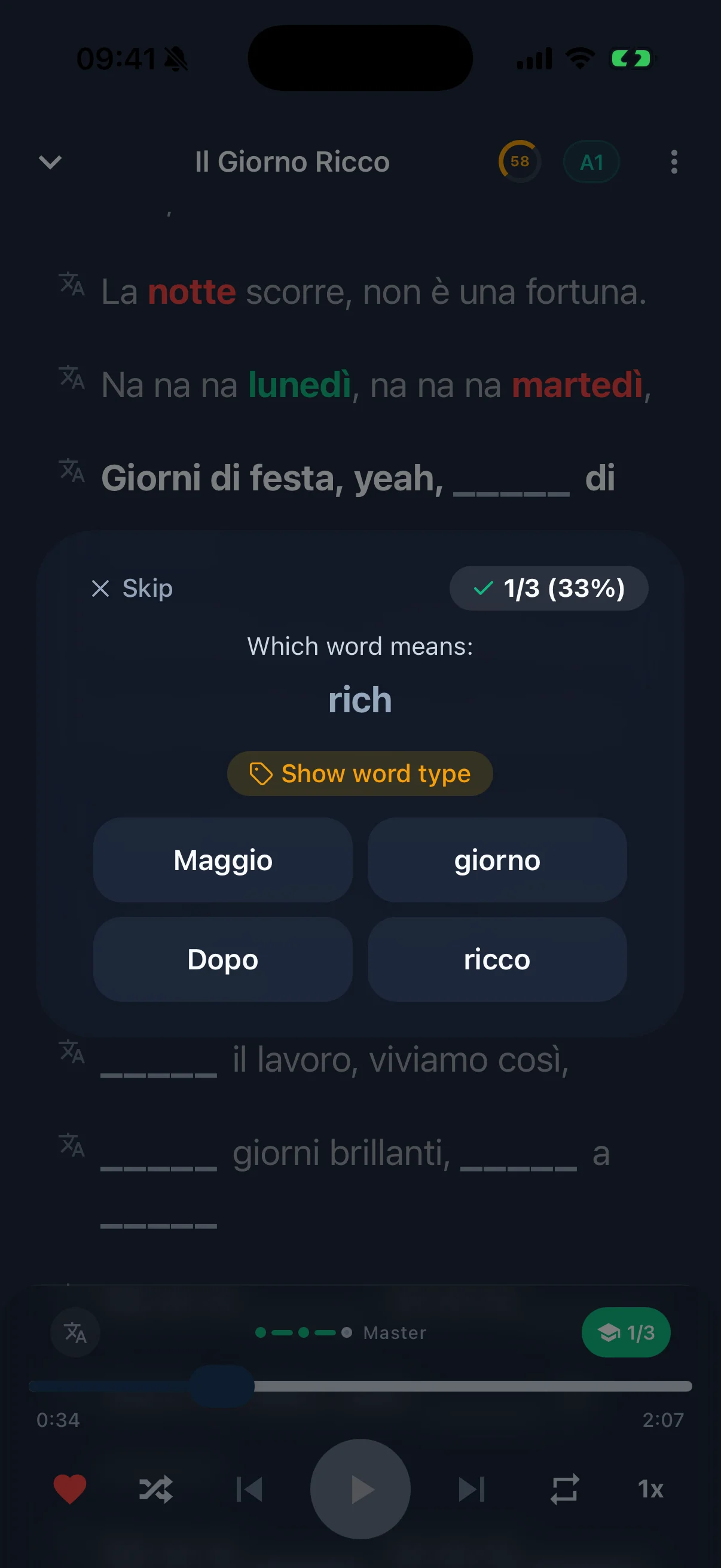
When the song plays, the lyrics run word by word in time with the audio, each word lighting up as it is sung. Tap any word to see what it means. Toggle the translation under a line when you want it and hide it when you do not, which is how you move from reading along to actually listening. There is a chorus loop control that plays the chorus three times over, the deliberate version of what you were doing with the rewind button anyway.
The retrieval half is built into playback. Turn quizzes on and the app blanks a vocabulary word out of the line you just heard and asks you to fill it, or shows you the English and asks for the Spanish, or shuffles the words of a line for you to reorder. Answer it and the app replays that exact line once so the correction arrives with the melody attached. Get one wrong and the word comes back for a second chance later in the song rather than being marked and forgotten. Every answer feeds an SM-2 spaced repetition schedule, so those words reappear on their own timetable in your review queue for days and weeks afterwards, which is the part that separates this from a lyrics video.
The track higher up this page went through exactly that. It was built from seven words: nervioso, valiente, sueño, esperar, reír, llorar and orgulloso. Notice how valiente comes back across more than one line rather than appearing once and vanishing. You can hear a live demo with the karaoke highlighting and the in song quiz running on the homepage.
What does a week of this actually look like?
One song is enough for a week if you use it properly. Here is a schedule that works both halves:
- Day 1. Pick your words and generate the song. Listen twice with the translations showing, then once with them hidden. Do not test yourself yet.
- Day 2. Play it once, quizzes on. Expect to miss two or three. Let the line replay do the correcting.
- Day 3. Skip the song entirely. Do your review queue instead, which is where those same words now live. This gap is the whole point.
- Day 5. Play it once more, quizzes on, and use the chorus loop on the one line you still fumble.
- Day 7. Try to say the chorus before you press play. Whatever you can produce cold is what you actually own.
- Week 2 onward. Let the spacing schedule handle it and spend your new song on the next batch of words.
The same weekly shape works whatever you are learning. It is the one we recommend on the German guide too, where the extra work goes into noun genders instead of speed, and on the Turkish guide, where songs carry long suffix chains that are painful to drill any other way.
You can try the whole loop without an account. Listening to the Discover library is free and your first song is a gift; after that the free tier gives you two custom songs a month, plus up to two more if you watch a rewarded video. Premium is $5.99 a month or $47.99 a year with a seven day trial, and raises that to fifteen songs a month with no ads. Available on iOS and Android, with the interface in English, Spanish, German, French, Italian and Turkish.
Get your first Spanish song free
Questions people ask
Can you really learn Spanish with songs, or is it just fun?
Both, but only if you add retrieval. Experiments have found a sung advantage for recalling and producing foreign phrases, and a two week study with Spanish speaking children found the sung group ahead on recall, pronunciation and translation. However, a four minute song exposure did not beat rhythmic speech for remembering what words meant. Song carries the sound and the sequence, and quizzes plus spaced review carry the meaning.
Which Spanish genre should a beginner start with?
Ballads and slow R&B, because they hold vowels long enough for you to hear every syllable and leave gaps between lines. Move to Latin pop once choruses feel comfortable, and save reggaeton and rap for when your comprehension is lagging behind your reading. Changing genre is the cheapest way to change difficulty without changing vocabulary.
Do I need to already know the song for this to work?
No, and an unfamiliar song is usually better. A song built around your own word list puts the words you keep failing in the chorus, where the repetition is, instead of leaving your vocabulary up to whatever the artist happened to write about. In Lingotify the Hook preset repeats your weakest words at least four times in a row for exactly this reason.