Learn Italian with Music: The Language Opera Was Built For
Yes, you can learn Italian with music, and Italian is the easiest major language to try it on. It has seven vowel sounds and no schwa, so singers do not smear unstressed syllables into mush the way English singers do. Its spelling lines up with its sound almost letter for letter. Opera was invented on top of that clarity, in Florence, in the late 1500s.
The method that works is not "put on an Italian playlist and absorb it." It is five moves:
- Choose the words first. Three to ten words you actually need, not whatever the chart happened to sing that year.
- Get them into one song with a chorus that repeats them, so the melody has something to carry.
- Read while you listen, word by word, so you can see where one word ends and the next one starts.
- Answer questions inside the song, right after the line that taught the word, while the tune is still in your ear.
- Review on a schedule, spreading the repeats across days, because the song on its own will fade.
The rest of this page is the long version: why Italian sings so clearly, what the research does and does not support, and how to run this on a single song this week. If you would rather see it than read about it, you can hear a live demo first.
Why does Italian sing so clearly?
Start with the vowels. Italian's phoneme inventory holds seven vowel sounds, /i/, /e/, /ɛ/, /a/, /ɔ/, /o/ and /u/, and no schwa, the colorless reduced vowel English leans on in unstressed syllables like the first sound of "about." That single absence does a lot of work. When an Italian singer stretches a syllable, there is a full, distinct vowel underneath it. When an English singer stretches an unstressed syllable, there is often nothing underneath but a smear, which is why you can love an English song for years and still not know what the second line says.
Then there is the spelling. Reading researchers rank writing systems by "orthographic depth," and Italian sits at the shallow end: consistent correspondences between letters and sounds. English sits at the deep end, with complex and inconsistent relations between the two. In Philip Seymour's comparison of European orthographies, English-speaking children needed about 2.5 years, more than twice as much time as most other languages, just to reach a basic decoding level. Italian groups with Finnish, Greek and Spanish among the simple, shallow systems.
That matters far more for music than it sounds like it should. Karaoke only teaches when reading and hearing agree with each other. In Italian, they do. You see giornata on the screen, you hear giornata in your ears, and the two channels stack. In English, the printed line and the sung line are two separate puzzles, and beginners end up solving neither.
Last, the history. A circle of artists, writers and musicians in Florence, known as the Florentine Camerata, set out in the late 1500s to recreate the storytelling of Greek drama through music, and Jacopo Peri's Dafne of 1597 is widely counted as the first opera. Four centuries of vocal writing then grew on top of a language whose vowels stay legible at volume. When you use Italian songs to learn, you are borrowing an instrument that was tuned for exactly this.
Glance at the demo lines further down this page: bella, dolce, mattina, stanza. Vowel endings give a singer something to hold, and they give your ear a clean edge to cut on.
Does listening to Italian songs actually teach you words?
Honest answer: the research supports the mechanism, not the fantasy. Nobody has shown that a playlist running in the background turns into Italian. What has been shown is more useful and more specific than that.
Karen Ludke, Fernanda Ferreira and Katie Overy gave sixty adults fifteen minutes with phrases in Hungarian, a language none of them knew, in one of three listen-and-repeat conditions: speaking, rhythmic speaking, or singing. The singing group came out ahead overall, and the advantage was statistically significant on the two tests that asked people to recall and produce the spoken phrases. Age, gender, mood, phonological working memory and musical training did not explain the gap.
The same paper points at an earlier result worth knowing. Listeners who heard a stream of sung syllables were able to identify word boundaries after roughly seven minutes of exposure, while listeners in a monotone speech condition performed at chance. Pitch gives your ear a handle on where one word stops. That is precisely the problem you have the first time an Italian chorus goes past at speed.
Melody by itself is not the magic, though. Patricia Purnell-Webb and Craig Speelman ran two experiments with a hundred participants each, teaching a four-verse ballad under familiar melody, unfamiliar melody, known rhythm, unknown rhythm and plain spoken conditions. Their finding: rhythm helped recall with or without musical accompaniment, and familiarity with the rhythm or the melody helped too. The scaffold works once the tune is known and repeating. A song you have heard once is not yet a memory aid. A chorus you have heard eight times is.
Which tells you exactly where "learn Italian with music" fails: passive listening. You do not know which words matter, you cannot hear the boundaries yet, and you never once try to produce anything. Fix those three and the same playlist becomes a study tool. We unpacked the mechanism in more detail in why music makes vocabulary stick.
Which Italian songs should you learn from?
There are three realistic routes, and they are good at different jobs.
| Route | Great at | Where it breaks | Best for |
|---|---|---|---|
| Real Italian records pop, cantautori, rap |
Natural speed, slang, culture, the pleasure that keeps you coming back | You do not choose the vocabulary; a lot of it is idiom or poetry you cannot reuse | Ear training and motivation |
| Graded listening textbook audio, podcasts for learners |
Level-appropriate words, clear diction, no guesswork | Rarely memorable; almost never sung; nothing repeats enough to lodge | Comprehension practice |
| Songs built from your word list | Your exact words, repeated in a chorus, at your level | Not culturally authentic; it is a study tool, not a record you would stream for fun | Getting specific words to stick |
Use both ends of that table. Real Italian music trains your ear on how the language is actually spoken and gives you a reason to keep going. It just cannot solve coverage: no Italian artist is going to sing prenotazione or bolletta for you, and those are the words that decide whether your week in Rome goes smoothly.
If you are picking real songs to study, three rules save a lot of frustration:
- Pick a repeating chorus over a clever verse. Repetition is the active ingredient. A song with a four-line hook that comes back three times will teach you more than a dense, brilliant verse that appears once.
- Pick a tempo you can hear. Fast Italian rap is a reward, not a starting point.
- Get the lyrics in text before you press play. Reading and listening at once is the exercise. Listening alone is entertainment.
The same three rules travel. They are what we would tell you if you were learning German with music, where the pain is compound nouns rather than vowels, or learning Spanish with songs, where the phonetics are nearly as friendly as Italian's.
How do you turn one Italian song into vocabulary you keep?
Here is the loop, in order. It takes about fifteen minutes per song and you can run it by hand with any lyrics site, or inside Lingotify, which was built to automate exactly these steps.
- Write down six words. Pull them from your last lesson, your last trip, or the three things you failed to say last week. Lingotify takes three to ten words per song, and fewer is stronger: each word gets more chorus time.
- Put them into one song with a chorus. In the app you pick a genre from eighteen options and a preset. The Hook preset takes your weakest one or two words and turns them into the repeated chorus phrase, appearing at least four times in the song.
- Listen once with the lyrics on the screen. Word-by-word karaoke highlights each word as it is sung, so you stop guessing where the boundaries are. Tap any word to see what it means, or flip the translation on a single line.
- Loop the chorus. The player has a chorus loop that repeats the hook three times and then lets the song carry on. This is the Purnell-Webb and Speelman finding made into a button: the tune has to become familiar before it can hold anything.
- Answer the in-song quiz. The song pauses on a vocabulary word and asks you for it, four ways depending on how well you know it: fill the blank, pick the Italian from the English, reorder the line, or type it. Right after you answer, the app replays the exact line you just answered and pauses, so the correction lands on the melody that carried the mistake.
- Let the misses come back. A word you get right is never asked again in that song, even when the chorus repeats it, and a word you miss comes back exactly once, later. No nagging, no free passes.
Che bella questa dolce mattina!
Il caffè profuma la stanza.
How beautiful this sweet morning! / The coffee makes the room smell good.
Seven words went into that one: mattina, caffè, pane, mangiare, bere, zucchero, frutta. They are ordinary A1 words, which is the point. The song is not trying to be art. It is trying to make seven specific words unforgettable by putting them somewhere your brain wants to replay.
What happens after the song stops being new?
This is the part most "learn a language with music" advice skips, and it is the part that decides whether you still know bolletta in March.
A song front-loads repetition: eight exposures in three minutes, all in one sitting. Memory research is unusually consistent about what happens next. The largest review of the spacing effect, by Nicholas Cepeda and colleagues, gathered 839 assessments across 317 experiments and found that the gap between study sessions and the length of time you need to remember something work together: the longer you want to hold onto a word, the wider the ideal gap between repeats. Massing everything into one happy afternoon with a chorus is the opposite of that.
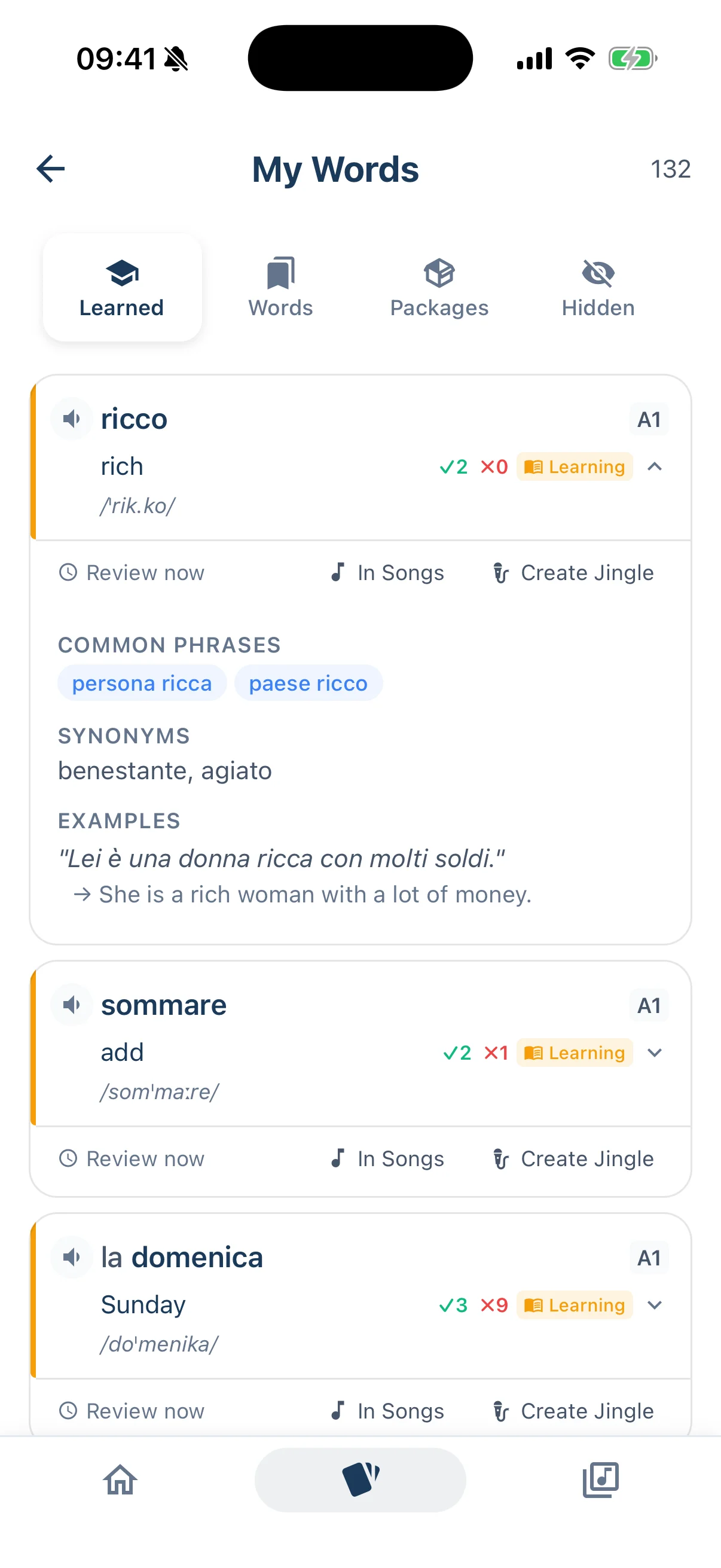
So the song is the encoding step, and something else has to run the schedule. Lingotify uses the SM-2 spaced repetition algorithm on every word the song taught you. Each word moves through states as you prove yourself on it: new, learning, mastered, then reinforced, with a struggling state waiting for the ones that keep slipping. Get one wrong and its interval collapses, and it comes back soon. Get it right quickly and it disappears for weeks. If you lapse on a single word eight times, it gets flagged as a difficult word and treated differently, because at that point repetition alone has clearly stopped working.
Each song also carries a score from 0 to 100 that reflects only how well you know the words in it. Replaying a song you never studied does not move the number. That is deliberate: a metric that rewards listening would let you feel productive while learning nothing, and we would rather the number tell you the truth. The same machinery runs behind learning French with music and learning Turkish with music, where the vowel harmony makes for surprisingly singable hooks.
How do you start this week?
Do not plan a system. Run the loop once, on one song, tonight.
Take six Italian words you have failed to remember at least twice. Pick a genre you would actually play in the car. Generate the song, put the lyrics on the screen, listen twice, loop the chorus, and answer the quiz. That is fifteen minutes. Tomorrow, do the two-minute review the app schedules for you and notice which of the six survived the night. That single observation, which words the melody carried and which it did not, teaches you more about your own memory than any study plan.
Lingotify's Discover library is free to listen to and your first song is a gift; after that you get two custom songs a month, plus up to two more if you watch a short video ad, and you can start without creating an account. Premium is $5.99 a month or $47.99 a year with a 7-day free trial, and gets you fifteen songs a month with no ads. Flashcards, karaoke and the in-song quizzes are all in the free tier. It is on iOS and Android, and it teaches Italian, German, Spanish, French, Turkish and English.
Frequently asked questions
Can you really learn Italian with music alone?
No, and anyone promising that is selling something. Music is exceptionally good at two things: making a phrase stick, and making you want one more repetition. The research supports that when the melody repeats and you are actively recalling, not just hearing. It does not replace using the words in reading, speaking, and scheduled review. Treat songs as the part of the day you look forward to, and let spaced repetition handle the rest.
Why is sung Italian easier to understand than sung English?
Italian has seven vowel sounds and no schwa, so unstressed syllables keep a full, distinct color instead of collapsing into a smear when a singer stretches them. Its spelling is also shallow, meaning letters and sounds line up consistently, so reading along reinforces what you hear rather than competing with it. Opera grew out of exactly that clarity in Florence in the late 1500s.
How many Italian words should one song cover?
Three to ten. That is the range Lingotify accepts, and it is a good rule anywhere. Fewer words means each one gets more repetitions in the chorus, and repetition inside a familiar tune is the entire mechanism. Ten words spread thin across three minutes will teach you less than five words hammered into a hook.