Learn French with music: how songs teach the melody of the sentence
Yes, you can learn French with music, and it works best when you treat the song as a listening drill rather than background noise. The short version: pick songs you can follow word by word, listen with the lyrics in front of you, sing the chorus out loud, and review the vocabulary again over the following days.

Music earns its place in French specifically because of how spoken French behaves. French runs its words together. Liaison and enchaînement push the final consonant of one word onto the opening vowel of the next, so un petit ami reaches your ear as three even syllables with no visible seams. Grammar books explain that in a footnote. A song teaches it by making you produce it in time with a beat, which is why plenty of learners can read a page of French and still fail to catch a sentence spoken at normal speed.
So the practical answer is this. A song hands you rhythm, repetition and a reason to say the line out loud, and a spaced review schedule turns the words you caught into words you keep. The rest of this guide covers what the research actually supports, how to choose songs that are worth the time, what one session looks like start to finish, and how to stop forgetting it all by Thursday.
Why does spoken French sound like one long word?
Because your ear is running the wrong parsing routine. French is syllable timed, and its listeners process it that way. In a 1986 study in the Journal of Memory and Language, Cutler, Mehler, Norris and Segui found that French listeners segment speech syllable by syllable while English listeners show no trace of the same routine, and that French listeners kept syllabifying even when the words in front of them were English. The conclusion was that different languages hand the listener different segmentation strategies. If you grew up with English, you are not simply short of French vocabulary. You are cutting the stream in the wrong places.
Liaison then makes the seams deliberately invisible. It misaligns word boundaries and syllable boundaries on purpose, which is why excellent tableau and excellent acteur sound nearly identical at the join. Bernadette Dejean de la Batie and Dianne Bradley tested exactly that contrast in Applied Psycholinguistics in 1995. Native listeners were essentially faultless at spotting the word initial consonant. Non-native listeners did not merely score lower, they solved the problem in a different way: rather than leaning on context the way teaching materials often advise, they fell back on guessing from an incomplete acoustic and lexical read of the signal.
There is a useful edge to that result. Being told what liaison is does not fix liaison. You fix it by meeting the same seam again and again until the whole phrase becomes one recognizable shape. A chorus does that for free, twenty times a song, and it does it at tempo.
The second thing songs teach is where the prominence sits. French does not stress individual words the way English does. Emphasis lands at the end of a rhythmic group, which is why a French sentence often feels like it is leaning forward toward its last syllable. Melody exaggerates that contour and locks it into a shape your mouth can copy. You learn the melody of the sentence first, and grammar arrives later to explain what you were already doing.
How French compares with Spanish, Italian, German and Turkish
Every language breaks in its own way, and the song has to attack the right break. French hides its word boundaries, so the job is segmentation and the chorus is the tool. Spanish keeps its boundaries mostly intact and moves fast instead, which makes it a friendlier place to start with sung input if you are choosing a first language; that route is covered in learning Spanish with songs. Italian shares the vowel clarity and adds a rhythm that is very forgiving to sing along with, covered in learning Italian with music.
German has close to the opposite problem: word boundaries are audible, but meaning gets packed into long compounds and a verb that arrives late, which is a different thing for a song to fix and is the subject of learning German with music. Turkish stacks suffix after suffix onto a single stem, so a song has to teach whole word shapes rather than short chunks; see learning Turkish with music. Same tool, different target.
Does singing actually help, or does it just feel good?
It helps, and the effect has been isolated from rhythm. Karen Ludke, Fernanda Ferreira and Katie Overy ran a controlled test published in Memory and Cognition: 60 adults learned Hungarian phrases in a 15 minute listen and repeat session, randomly assigned to speaking, rhythmic speaking, or singing. The singing group performed better overall, and the advantage reached statistical significance on the tests that required participants to produce the Hungarian phrases out loud. Rhythmic speaking, which keeps the beat but drops the tune, did not deliver the same benefit. The melody was the ingredient.
Wanda Wallace's 1994 experiments explain a piece of why, and they come with a warning attached. Text was recalled better sung than spoken, but only when the same melody repeated across verses. When people heard a single verse sung, or a different melody for every verse, the spoken version won instead. Melody helps because it chunks a line, fixes its length and marks where the stresses fall. A melody you have not learned yet is just extra load on top of a language you have not learned yet.
That is the most actionable finding in this whole area, and most people get it backwards. Novelty is not the point. Repetition of the tune is doing the work. Three French songs you know inside out will teach you more than thirty you have heard once. We go deeper into the mechanism in why music makes vocabulary stick.
Pick fewer songs and replay them. A repeated melody is what turns a lyric into a memory hook. A shuffle of unfamiliar French tracks is listening practice, not learning.
Which French songs should you actually learn from?
There are three realistic sources, and they fail in different places. Chart French is authentic but arbitrary: the vocabulary is whatever the songwriter felt like, the tempo is unforgiving, and the words you personally keep forgetting are almost certainly not in it. Learner playlists fix the clarity problem and create a new one, because someone else picked the words. The third option is to build the song around your own list.
| Approach | Strong at | Breaks down when | Best if you are |
|---|---|---|---|
| Real French chart songs | Authentic liaison, real tempo, culture and slang you will actually hear | The vocabulary is random, delivery is fast, and your target words may never appear | B1 and above, or listening for pleasure alongside study |
| Learner playlists and slow covers | Clear diction, gentle tempo, low frustration on day one | The word list is someone else's, and the songs wear out after a few plays | A1 to A2 and just getting your ear in |
| Songs built from your own word list | Every word you need is in the lyrics, and the chorus repeats the ones you keep failing | It is not a chart hit, and the song is only as good as the list you feed it | Anyone with a review pile they keep forgetting |
That third row is what Lingotify does. You pick between three and ten French words, choose a genre, and the app writes and records a song that uses all of them. The Hook preset takes the one or two words your spaced repetition data says you are weakest on and turns them into a contiguously repeated chorus phrase, hit at least four times in the song. That is Wallace's repeated melody condition, aimed at the exact words you keep dropping.
What does one French session with music look like?
Six steps, roughly fifteen minutes, and every one of them is something you do rather than something you play in the background.
- Listen once with nothing in front of you. Do not read along. You are finding out which parts of the line dissolve, and those spots are your actual lesson.
- Play it again with word by word karaoke. Each word lights up as it is sung, so the seam you could not hear becomes a seam you can see. Liaison stops being abstract the moment you watch two words share a consonant in real time.
- Tap whatever you missed. Tapping a word in the lyrics opens its translation and plays its pronunciation, and you can save it to your vocabulary from there. Per line translations sit under the lyric when you want them and hide when you do not.
- Loop the chorus. Lingotify has a chorus loop that replays the chorus three times in a row. This is the part learners skip and the part the research keeps pointing at.
- Answer the in-song quizzes. With the quiz toggle on, playback pauses on a vocabulary word and asks you to fill the blank, pick the French word from its translation, or reorder the line. Hints go part of speech, then first letter, then full translation, and a hinted answer counts for less. After you answer, the app seeks back to that line and plays it once so you hear the word in place.
- Sing it. The Ludke result was strongest on the tests that made people produce the phrase aloud. Producing it is not optional.
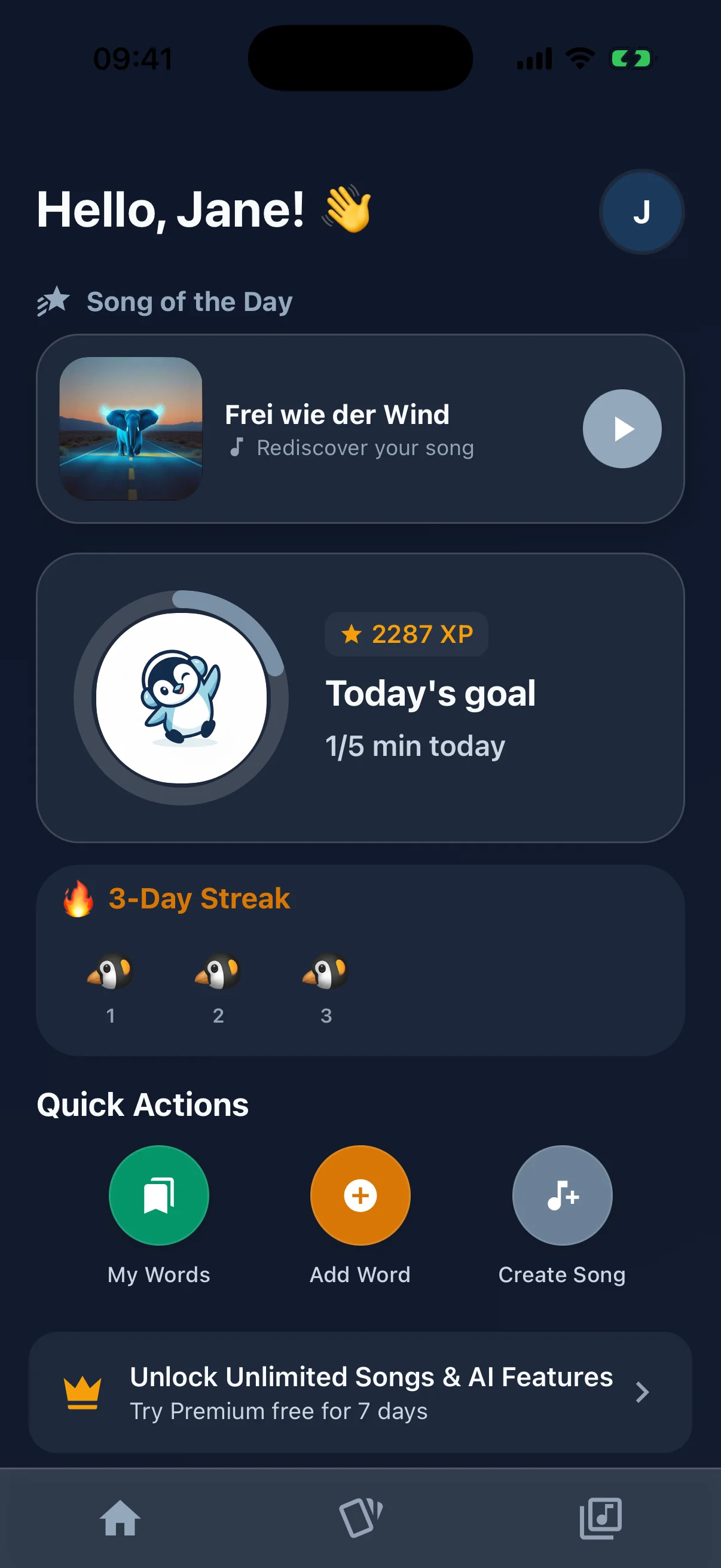
Je commence à couper les légumes frais.
Nous voulons cuisiner un bon repas.
I start to chop the fresh vegetables. / We want to cook a good meal.
Listen to those two lines at speed and you can hear the problem this page is about. Commence à arrives as one continuous run, and cuisiner un is where the words fuse. Read on the page, both are easy. Sung at tempo, they are the whole exercise. You can also hear a live demo on the homepage before you install anything.
Get your first French song free
How do you stop forgetting the words a week later?
The song gets a word into your head. Spacing keeps it there. This is one of the most heavily replicated findings in learning science: Cepeda, Pashler, Vul, Wixted and Rohrer synthesized 839 assessments of distributed practice across 317 experiments in 184 articles for Psychological Bulletin in 2006. Spreading study out beat cramming it together, and the gap that produced the best retention grew as the delay before the test grew. If you want a word next month, review it on a widening schedule, not five times tonight.
Lingotify runs the SM-2 algorithm underneath the music, so every quiz answer in a song is also a review. Answer well and the word's next review moves further out. Miss it and the interval collapses and the word comes back sooner. Words move through mastery states from new to learning, then to mastered and reinforced, and a word you keep failing gets flagged so it can be pushed into the chorus of your next song.
- Answer inside the song. An in-song quiz answer writes to the same spaced repetition record as a flashcard, so listening counts as reviewing.
- Let the schedule widen. Same day, then a day, then a few days, then longer. The Cepeda synthesis says the right gap depends on how long you need to remember it.
- Re-listen to old songs. Review Mix builds a playlist of the songs that cover the words currently due, so revision arrives as music rather than a queue of cards.
One more habit worth stealing. When a French word will not stick after several passes, do not grind it in isolation. Put it back into a new song with the Hook preset and let the chorus hammer it. That is the closest practical version of the Wallace condition that actually worked.
Frequently asked questions
Can you really learn French with music, or is it just listening practice?
You can learn from it, but only if the song is doing more than playing. Music helps when the tune repeats so the line becomes a fixed shape, when you can see the words as they are sung, and when you review the vocabulary again days later. Passive listening with no text and no review is closer to ambience than to study.
Do I need French grammar before I can learn from songs?
No. Songs are useful earlier than grammar is. A chorus teaches you the shape and rhythm of a phrase, including the liaisons that make spoken French so hard to cut into words, long before you can explain why the phrase is built that way. Grammar then has something concrete to explain instead of an abstraction.
How many French songs do I need?
Fewer than you think. Wallace's experiments found that a repeated melody is what makes sung text stick, so three songs you know by heart beat thirty you have heard once. Your first Lingotify song is a gift, and after that the free tier gives you two custom songs a month plus up to two more from rewarded videos, which is enough to keep a small rotation going.
French is learned by ear before it is learned by rule. Build a short rotation of songs that carry your own words, listen with the lyrics visible, sing the chorus, and let the spacing do the rest.
Sources: Cutler, Mehler, Norris and Segui (1986), Journal of Memory and Language 25, 385 to 400. Dejean de la Batie and Bradley (1995), Applied Psycholinguistics 16, 59 to 81. Ludke, Ferreira and Overy, Memory and Cognition, singing and foreign language learning. Wallace (1994), Journal of Experimental Psychology: Learning, Memory, and Cognition 20, 1471 to 1485. Cepeda, Pashler, Vul, Wixted and Rohrer (2006), Psychological Bulletin 132, 354 to 380.