Learn German with music: how melody makes der, die, das stick
Yes, you can learn German with music, and there is real experimental evidence behind it. Adults who learned unfamiliar foreign phrases by singing them produced more of those phrases verbatim afterwards than adults who spoke the same phrases or spoke them in rhythm, after a learning period of only fifteen minutes.

The mechanism is not mysterious. A melody cuts a sentence into fixed chunks, locks down where the stress falls, and hangs a second, non verbal memory trace on the same words. That matters more in German than in most languages, because the two things that torment beginners, the gender of every noun and the verb that wanders off to the end of the clause, are problems of retrieval speed inside a phrase, not problems of knowing a rule.
Here is the whole method in four steps:
- Use your own words. A German chart hit teaches you its vocabulary. A song built from the nouns you keep failing teaches you yours.
- Make the chorus repeat. The memory benefit of melody depends on the tune coming back. One verse, sung once, does close to nothing.
- Read while you listen. Word by word text under the audio stops you learning a confident mishearing.
- Review on a widening schedule. Spacing beats cramming, and a song you can already hum is the cheapest review session that exists.
Does learning German with music actually work, or does it just feel productive?
The cleanest evidence is a study by Karen Ludke, Fernanda Ferreira and Katie Overy in Memory & Cognition. Sixty adults were split across three listen and repeat conditions, speaking, rhythmic speaking and singing, and spent fifteen minutes learning phrases in Hungarian, a language none of them knew. The singing group came out ahead overall, significantly so on the two tests that forced participants to produce spoken Hungarian from memory. The authors also checked the obvious objection, that the musical people simply did better: age, gender, mood, working memory and musical training did not explain the gap.
Two details decide how you use that. The benefit showed up on verbatim production, precisely the skill that collapses when your German stops dead after "Ich hätte gern...". And it was a fifteen minute phrase learning study, so nobody has shown that singing makes you fluent. Any app promising that is selling something it cannot deliver.
The second piece is older and more useful. Wanda Wallace ran experiments on melody and text recall and found that sung text was recalled better than spoken text only when the melody repeated across verses. Three verses to the same tune, and recall improved. A single verse, or a different tune per verse, and the spoken version came out ahead. Melody is not a coating you spray on vocabulary. It is a structure that has to be learned first, and it gets learned by repeating.
Underneath both findings sits dual coding theory, developed by Allan Paivio and applied to teaching by James Clark and Paivio: material encoded through two systems has more routes back to it than material encoded through one. Melody is not mental imagery, which is what Paivio actually studied, but it behaves the way the theory predicts. You lose the word, you still have the tune, and the tune walks you back to the word.
Which is why Lingotify's Hook preset does one specific thing: it takes the one or two words your spaced repetition data says you are worst at and builds the chorus around them, repeated at least four times over. Wallace's finding turned into a setting.
Why do der, die and das refuse to stick?
Because knowing a noun's gender and retrieving it in real time are two different skills, and only the first one shows up on a flashcard.
Susan Bobb, Judith Kroll and Carrie Jackson tested exactly this in Bilingualism: Language and Cognition. Native German speakers and intermediate to advanced learners did a speeded translation recognition task. The natives were interfered with when a wrong translation happened to share the gender of the right one, the fingerprint of gender being processed automatically as the word is accessed. The learners showed no such interference. Yet those same learners, asked outright which article a noun took, could assign it correctly.
Read that twice. They knew der, die and das. They could not get at that knowledge at the speed of speech.
Drilling a gender list improves the explicit knowledge, which was never the bottleneck. It never touches retrieval under time pressure with a sentence wrapped around it, because you never practise that. A sung line is exactly that. The article stops being a fact to look up and becomes a syllable inside a shape you already know, landing on a beat you expect. "Das Schwein springt" is one chunk with one melody. You never decide that Schwein is neuter, because the line does not scan any other way.
Three things in the app are built around that. The article rides along with the noun when you choose your words, so it never appears naked in the lyrics or the review cards. German capitalization is graded when you type an answer back during a song, so Kassenbon has to be Kassenbon. And every word is shown in its real casing everywhere, hints and options included, so you are not quietly memorising "schwein" alongside its gender.
What does a melody actually do to a German sentence?
Wallace's framing is worth stealing: music chunks words and phrases, marks how long a line is, fixes the stress pattern, and pushes your attention onto surface form. German has three notorious features that are all, structurally, problems of holding a long span together. Melody is unusually good at long spans.
The verb that arrives last
In a subordinate clause the conjugated verb goes to the end, and beginners lose it somewhere in the middle of the trip. "Ich weiß, dass er jeden Morgen um sieben Uhr aufsteht" is a long walk to that aufsteht. A melodic line gives the walk a beginning, a middle and a landing, and the landing is where the verb lives. You stop remembering a rule and start remembering a cadence.
Separable verbs
Separable verbs split, and the prefix travels to the end of the clause: aufstehen turns into "steht ... auf". The gap between the halves is what learners drop. Sung, that gap is a fixed number of beats, which makes it a shape instead of an accident.
Compound nouns
Geschwindigkeitsbegrenzung is not hard because it is long. It is hard because you have never said it at speed. Rhythm is a syllable delivery system: a compound noun that lands on a beat gets produced as one unit, rather than assembled nervously from parts while the other person waits.
Below are two lines from a real A2 German song generated inside the app. Nothing about them is clever, and that is the point: short, concrete, singable, article welded to the noun.
Der bunte Papagei will tanzen.
Das kleine Schwein läuft heute so schnell.
The colorful parrot wants to dance. / The little pig is running so fast today.
In the app that chorus earns its keep. Each word lights up as it is sung, the line translation toggles off once you stop needing it, and tapping any word shows its meaning without stopping the track.
Which German problems belong in a song, and which do not?
Music is not a general purpose grammar teacher, and pretending otherwise is how people end up with a great playlist and no German. The honest split:
| German sticking point | Why lists and rules alone fail | What to put in the song |
|---|---|---|
| Noun gender (der, die, das) | Explicit knowledge does not become fast retrieval on its own | The noun with its article, inside a chorus line that repeats |
| Verb final word order | You know the rule and still lose the verb mid sentence | Whole subordinate clauses, one per melodic line |
| Separable verb prefixes | The halves get learned apart and never rejoin | Lines where the prefix lands on the final beat |
| Vocabulary you keep failing | Isolated words decay fast and out of context | 3 to 10 words, each used in one concrete scene |
| Pronouncing ch, ü and the German r | Reading gives you no feedback at all | Sung lines you imitate out loud, slowly at first |
| The case system as a system | Needs explaining once, not exposure a hundred times | Not this. Read a grammar reference, then let songs supply examples |
| Formal and business register | Songs skew informal, concrete and emotional | Not this. Read and write in the register you need |
The rule of thumb: if something needs to be understood once, read about it. If it needs to be available in a quarter of a second, put it in a chorus.
How do you turn one catchy song into long term memory?
By returning to it on a widening schedule, and by forcing yourself to produce the words rather than recognise them.
The spacing half is settled science. Nicholas Cepeda, Harold Pashler, Edward Vul, John Wixted and Doug Rohrer pulled together 184 articles, 317 experiments and 839 assessments of distributed practice and found that spaced study beats massed study, and that the gap producing the best retention grows as the delay before the test grows. If you want your German words available next month rather than tonight, reviews should stretch out rather than bunch up.
The producing half separates a song you enjoy from a song that teaches. Passive listening feels like studying and is much closer to background music. The fix is tiny: pause, cover the line, say the word, then check.
Lingotify automates both halves. Every word carries SM-2 spaced repetition state, so a word you get right returns in a day, then three days, then on an interval that widens according to how easy that word has been for you, while a word you get wrong drops back and comes around again quickly. During playback the song quizzes you on your own vocabulary in whichever line is on screen: fill in the blanked word, pick the German word from a prompt in your language, or drag a scrambled line back into order. Get one wrong and you get exactly one more attempt later in the song. Get it right and that word is never asked again in that song, even when the chorus comes back for the fourth time.
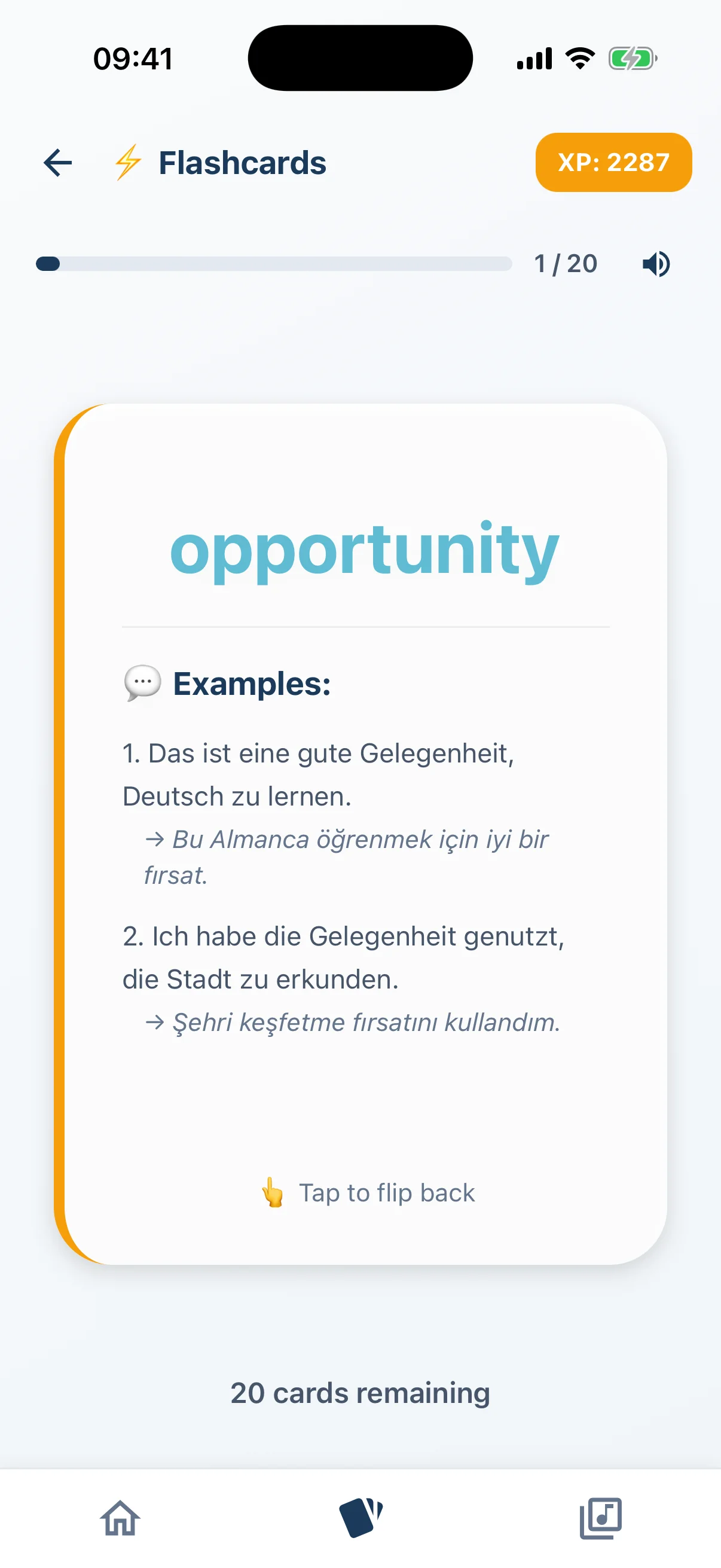
The best detail is the smallest one. After you answer, the player seeks back to the line you just answered, plays it once, and pauses. You hear the correct version, sung, in the two seconds when you most want to know it.
Make your first German song free, and put your own der, die and das in the chorus.
What does a week of learning German with music look like?
Twenty minutes a day, most of it not really work.
- Pick 3 to 10 words you actually failed this week, with their articles. Not a tidy list from a textbook. The ones that beat you.
- Generate one song in a genre you could tolerate on repeat. Kids Pop and straight Pop are clearest at A1 and A2, because the arrangement stays out of the way of the words.
- First listen with everything on. Word by word highlighting, translations visible, quizzes off. You are only matching sound to spelling here.
- Second listen with quizzes on. Answer in the moment, let the line replay, keep moving. Do not restart to chase a perfect score.
- Days two to seven, sing it badly in the shower, then do the two minute flashcard review the app schedules for those words.
- Next week, new words, new song. The old one stays in your library and resurfaces as a review track when its words fall due.
You do not need a subscription to test this. Listening to the Discover library is free and your first song is a gift; after that the free tier gives you two custom songs a month, plus up to two more if you watch a rewarded video, which is enough for a fair trial. Premium is $5.99 a month or $47.99 a year with a seven day free trial, and raises the limit to fifteen songs a month. Current prices and limits are shown in the app before anything is charged.
German is not the only language where this works. If you are fighting gendered nouns elsewhere too, the same chorus trick does the heavy lifting in our guides to learning Spanish with songs and learning French with music. Where the hard part is suffixes stacking up rather than articles, see learning Turkish with music, and for the language that rewards singing out loud most, try learning Italian with music. For the cognitive science on its own, without the German, we wrote it up in why music makes vocabulary stick. Or skip the reading and hear a live demo on the home page.
Start with one free German song and see whether the chorus beats your flashcards.
Frequently asked questions
Can I learn German with music if I cannot sing?
Yes. The published experiment compared singing against speaking and rhythmic speaking, and reported that musical ability and training did not explain the singing group's advantage. Nobody is grading your pitch. Singing quietly, or even mouthing the line in time, still gives you the chunking and the stress pattern, where most of the benefit lives.
Is German pop music enough, or do I need songs made from my own words?
Real German music is excellent input and you should listen to plenty of it. It is simply not targeted: the words you keep failing are unlikely to turn up in the chorus of a chart hit. A song generated from your own failed vocabulary puts those exact words in the most repeated part of the track, the part memory research says does the work.
How long before music helps with der, die and das?
For one noun, you will notice the article arriving automatically after a handful of listens, because that noun is now attached to a melody instead of a rule. Across your whole vocabulary it is a matter of months of spaced review rather than days, and any timeline more precise than that would be invented.