How to memorize vocabulary fast
Speed in vocabulary learning is mostly a scheduling problem wearing a motivation costume. The seven methods below are ordered so the two that carry the most weight come first.
To memorize vocabulary fast, test yourself on each word instead of rereading it, and spread those tests across days rather than stacking them into one evening. Those two moves do most of the work. Five others make each exposure count for more: build a sound bridge from a word you already know, attach an image or a voice so the word has a second route back, meet the word inside a sentence that gives its meaning away, learn a batch shortly before sleep, and set your hardest items to a melody that repeats. Each method below is tied to a published study, and each study comes with limits worth knowing.
Retrieval first. Spacing second. Everything after that is amplification: keyword bridges, dual coding, informative contexts, sleep, melody. On a bad week, drop an amplifier. Never the first two.
1. Test yourself before the word feels learned
Rereading a word list feels productive. It measures nothing, which is the problem.
Henry Roediger and Jeffrey Karpicke ran the comparison directly (Roediger and Karpicke, 2006). Students studied prose passages, then either took recall tests with no feedback or restudied the same number of times. Five minutes later, restudying won. After two days and after a week, the tested students remembered substantially more, though repeated studying had left them feeling more confident. Confidence and retention came apart, which is why the better method feels worse while you use it.
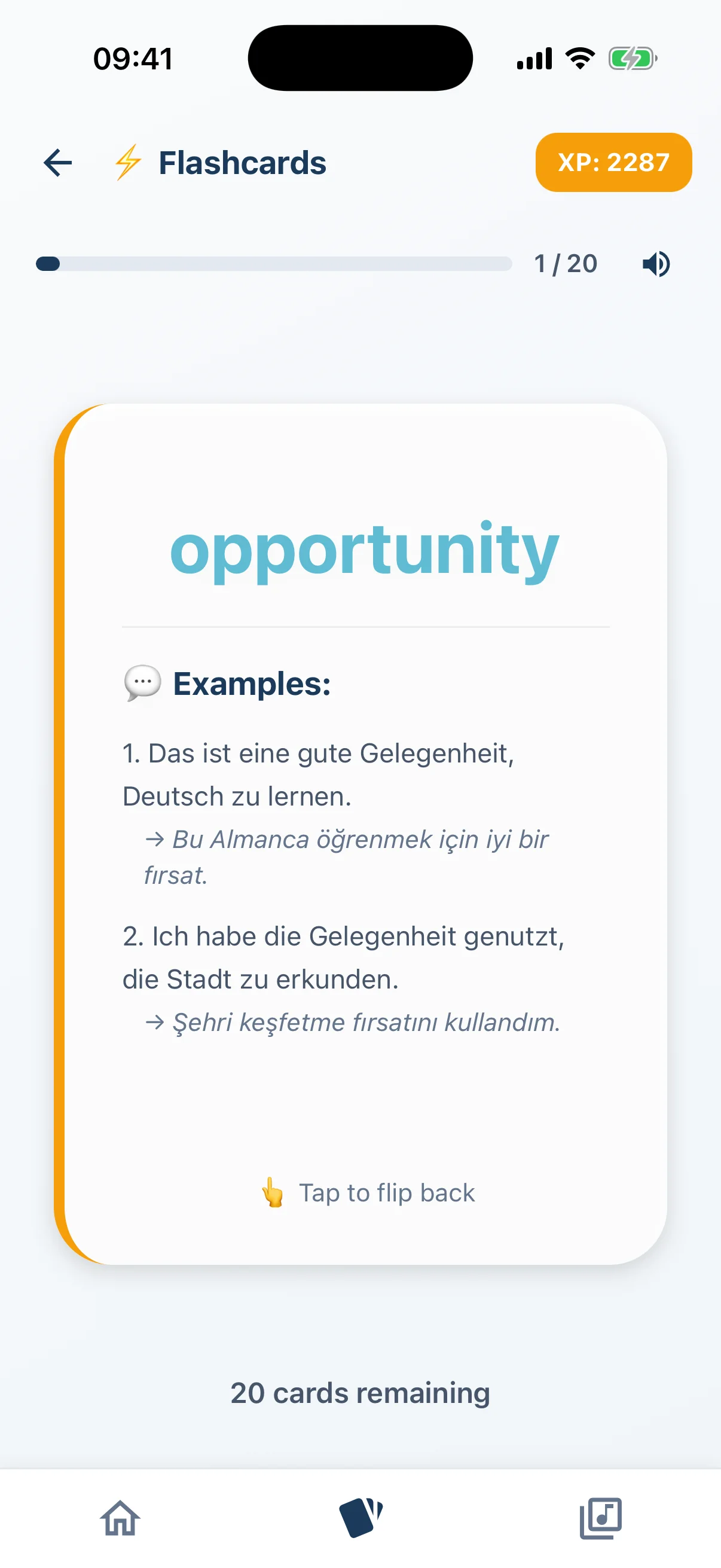
On a vocabulary list: cover the German column, read "the bill", and say die Rechnung out loud before you look. A wrong guess counts, as long as you produced something. The attempt is the event, not the checking.
One caveat. The experiment used prose passages in the students' own language, not foreign word pairs. Take it as a principle about how memory behaves rather than a measurement of your deck.
2. Space the tests out, then stretch the gaps
The synthesis behind this one is unusually large. Nicholas Cepeda and colleagues pooled 839 assessments of distributed practice from 317 experiments across 184 articles (Cepeda and colleagues, 2006). Spaced study beat massed study, and the gap between sessions that produced the best retention grew as the delay before the test grew.
That second half is the part people miss. If the exam is Friday, reviews across this week are fine. If you want the word next year, the gaps should run into weeks and then months, and ten reviews tonight buy you tomorrow morning and very little else.
A ladder for a word you met today: tonight, in two days, in a week, in three weeks. Any app running SM-2 does that arithmetic for you, which is the whole reason spaced repetition software exists.
3. Build a sound bridge with the keyword method
Richard Atkinson laid out the keyword method in American Psychologist in 1975 (Atkinson, 1975). It splits the job in two. First you link the spoken foreign word to a keyword in your own language that sounds like part of it. Then you form a mental image of that keyword interacting with the translation.
German Teppich means carpet and opens like "tepee". Picture a tepee pitched in a living room, poles denting the pile of the rug. Turkish kapı means door and lands near "copy", so put a photocopier where your front door should be.
Interacting is the load-bearing word. A tepee beside a carpet leaves two objects to remember; a tepee standing on it is one scene, and a scene comes back as a unit. The method earns its keep on concrete nouns with an obvious sound-alike and stalls on abstract ones. Once the word arrives without the tepee, drop the tepee.
4. Give the word a second code
Allan Paivio's dual coding theory describes two cooperating memory systems, one verbal and one non-verbal, and argues that material represented in both is retrieved more reliably than material represented in only one, because either code can trigger recall (Paivio, 1991).
A written pair gives you one route in. The same word with a picture attached, a recorded voice saying it, or a scene you genuinely imagined gives you several.
So for Spanish la factura, do not stop at writing "the invoice". Picture one specific invoice, the one taped to your fridge, and hear the word out loud once. Two seconds of work, two extra cues.
Paivio studied the non-verbal code mainly through visual imagery rather than sound, so treating melody or a recording as a second code extends the theory rather than reporting a result from it.
5. Meet the word in a sentence that gives it away
Stuart Webb tested how much the surrounding sentence matters (Webb, 2008). Japanese university students learning English met ten target words across three sets of short contexts, with one group's contexts rated as carrying more clues to meaning. A surprise test afterwards checked recall of form, recognition of form, recall of meaning and recognition of meaning.
Webb reports that context quality, rather than the number of encounters, may have the greater effect on knowledge of meaning, while frequency of encounters had more influence on knowledge of form.
Meaning and spelling are on different diets, roughly. To learn what Vorschlag means, "Sie hat einen guten Vorschlag gemacht, und alle waren einverstanden" hands you far more than "Das ist ein Vorschlag" does. To spell it, you still need the repetitions. One study, ten words, so read it as a direction rather than a dosage.
6. Learn a batch, then sleep on it
Steffen Gais, Brian Lucas and Jan Born tested sleep and vocabulary in high school students across two experiments (Gais, Lucas and Born, 2006). Declarative memory was better when sleep followed within a few hours of learning, independent of time of day, and with equal amounts of interference during the retention intervals. Sleep deprivation hurt memory, and the effect was still significant after a night of recovery sleep.
"Independent of time of day" is the clause that makes this usable. Not a morning-people effect, not fatigue during the test. What moved was the distance between learning and sleeping.
So if you have twenty new words and two possible slots, use the slot closest to bedtime. Ten minutes at 10:40pm likely serves you better than the same ten minutes at 8am followed by a full day awake.
7. Put the hardest words in a chorus
Karen Ludke, Fernanda Ferreira and Katie Overy randomly assigned sixty adults to learn Hungarian phrases by listen-and-repeat in one of three conditions: speaking, rhythmic speaking, or singing (Ludke, Ferreira and Overy, 2014). After fifteen minutes the singing group performed better overall, significantly so on the two tests that required producing spoken Hungarian from memory. Age, gender, mood, phonological working memory and musical training did not explain it.
Wanda Wallace found the condition that makes melody work at all (Wallace, 1994). Sung text was recalled better than spoken text only when the same melody returned across verses. A single sung verse, or a different melody per verse, and speaking won. Which is why the chorus is the part of a song you can still sing a decade later, and the right parking spot for the six words you keep failing.
Crude versions work. Take your worst word this week, write a four-beat line containing it, and sing that line to a tune you already know, without changing it.
Lingotify does this deliberately. You hand it the words you are failing and it generates a song around them, with the Hook preset building a chorus that brings your weakest one or two items back at least four times. Karaoke lights each word as it is sung. In-song quizzes blank a word out of the line you just heard, which is method 1, and every answer feeds an SM-2 schedule, which is method 2. Your first song is a gift, then two custom songs a month are free, plus two more for watching a rewarded video.
A seven day version you can actually run
Monday night, five minutes before bed: meet twelve new words, each inside a sentence that reveals its meaning. Tuesday morning: cover the answers and produce all twelve out loud, wrong guesses included. Tuesday night: keyword images for the four that failed. Wednesday: nothing. Thursday: test again, then put whatever still fails into a chorus. The following Monday: test all twelve and push the survivors out to three weeks.
No step takes more than ten minutes, and no step requires you to feel motivated, which is the only design constraint in language learning that has ever proved reliable.
Where to go next
The cognitive science behind that last method is in why music makes vocabulary stick, and the shorter answer to the question most people ask first is in do songs help you learn a language. For the whole stack applied to one language, the guide to learning German with music runs it against der, die and das.
Frequently asked questions
What is the fastest way to memorize a long vocabulary list?
Break it into batches of ten to fifteen, test each batch by producing the word from memory rather than rereading it, and schedule the batches so each returns after a day, then a few days, then a few weeks. Roediger and Karpicke found retrieval beat restudying on delayed tests, and the Cepeda synthesis found the best gap grows with how long you need to remember. Long lists fail because they get crammed, not because they are long.
How many new words a day can I actually memorize?
There is no honest universal number. It depends on how similar the words are, how much of the language you already have, and how many reviews you are willing to carry later. Ten to twenty new items a day is a ceiling most learners sustain. Twenty new words with no review schedule is slower than seven with one.
Do songs really help, or does it just feel good?
Both, with a condition attached. Ludke, Ferreira and Overy found a singing group outperformed speaking and rhythmic speaking groups on producing learned phrases from memory. Wallace found sung text beat spoken text only when the same melody repeated across verses, so a song helps when the tune returns and hurts when it keeps changing. Music strengthens a memory; it does not schedule one.
Sources
- Roediger, H. L., and Karpicke, J. D. (2006). Test-enhanced learning: Taking memory tests improves long-term retention. Psychological Science, 17(3), 249 to 255. pubmed.ncbi.nlm.nih.gov/16507066
- Cepeda, N. J., Pashler, H., Vul, E., Wixted, J. T., and Rohrer, D. (2006). Distributed practice in verbal recall tasks: A review and quantitative synthesis. Psychological Bulletin, 132(3), 354 to 380. doi.org/10.1037/0033-2909.132.3.354
- Atkinson, R. C. (1975). Mnemotechnics in second-language learning. American Psychologist, 30(8), 821 to 828. eric.ed.gov/?id=EJ123584
- Paivio, A. (1991). Dual coding theory: Retrospect and current status. Canadian Journal of Psychology, 45(3), 255 to 287. doi.org/10.1037/h0084295
- Webb, S. (2008). The effects of context on incidental vocabulary learning. Reading in a Foreign Language, 20(2), 232 to 245. eric.ed.gov/?id=EJ815123
- Gais, S., Lucas, B., and Born, J. (2006). Sleep after learning aids memory recall. Learning & Memory, 13(3), 259 to 262. pubmed.ncbi.nlm.nih.gov/16741280
- Ludke, K. M., Ferreira, F., and Overy, K. (2014). Singing can facilitate foreign language learning. Memory & Cognition, 42(1), 41 to 52. doi.org/10.3758/s13421-013-0342-5
- Wallace, W. T. (1994). Memory for music: Effect of melody on recall of text. Journal of Experimental Psychology: Learning, Memory, and Cognition, 20(6), 1471 to 1485. doi.org/10.1037/0278-7393.20.6.1471