The best French songs for beginners, and what each one teaches
Start with Je te laisserai des mots, Aux Champs-Élysées and Comme des enfants. Then Zaz, whose chorus is a grammar drill wearing a jazz hat.
Those four carry a beginner further than most graded listening material, and every song below already turns up on teacher playlists and classroom worksheets. Cœur de pirate is a fixture in North American immersion classes. The Patrick Watson track is the first French-language song to pass a billion streams on Spotify, so the lyrics are transcribed everywhere. I spread the picks across seventy years, because a playlist you never replay teaches you nothing.
The level calls are my own, based on how much of a song a learner can actually decode on a third pass. Each entry names the words and structures it drills.
| Song | Artist | Level | Why it works |
|---|---|---|---|
| La vie en rose | Édith Piaf (1946) | A1 to A2 | Every syllable gets its own real estate |
| Ne me quitte pas | Jacques Brel (1959) | A1 refrain, B1 verses | A negative imperative you cannot mishear |
| Aux Champs-Élysées | Joe Dassin (1969) | A1 | Hands you il y a on repeat |
| Le Festin | Camille (2007) | A2 | A full comparison at talking speed |
| Comme des enfants | Cœur de pirate (2008) | A1 to A2 | Regular ER verbs, Quebec vowels |
| Je veux | Zaz (2010) | A2 | Three partitive articles in one breath |
| Je te laisserai des mots | Patrick Watson (2010) | A1 | Twenty words, one verse, no rush |
| Elle me dit | Mika (2011) | A2 | Reported speech plus imperatives, over and over |
| Papaoutai | Stromae (2013) | A2 | Spoken French, contractions included |
| Dernière danse | Indila (2013) | A2 to B1 | Diction sharp enough to transcribe by ear |
What makes a French song beginner-friendly
Four things, and being a great song is not one of them.
- Syllables per second. French has no heavy stress accent to chop the stream into pieces, so tempo does all the separating. Under about four syllables a second you can hear where one word stops.
- A singer who lands the endings. Liaison and elision already fuse words together. A mumbler on top of that hands you one continuous sound with no seams.
- A chorus that returns unchanged. The repeated melody does the memory work. A verse you hear once does almost nothing.
- Ordinary vocabulary. Rain, money, doors, children.
Which is why French rap, however good it has gotten, is the wrong place to begin. Same for late Gainsbourg and most of Barbara, gorgeous and half-swallowed. Save them for B2.
The ten songs
1. La vie en rose, Édith Piaf
Recorded in 1946 to Piaf's own lyrics, and still about the slowest famous song in the language. Every syllable gets room. The verse hands you a clause you can lift whole: quand il me prend dans ses bras, where me sits in front of the verb exactly where French wants it and English refuses to put it. Also le bonheur (happiness), les mots d'amour, and tout bas (softly, under the breath). If a first French song is meant to prove you can pick out individual words, this is the one.
2. Ne me quitte pas, Jacques Brel
From 1959, and Brel enunciates like a man giving evidence under oath. The title is the most useful grammatical object on this list: ne me quitte pas is a negative imperative with the object pronoun wedged in the middle, ne plus me plus verb plus pas, a shape your course book will postpone for months. From the rest: oublier (to forget), le temps, l'ombre (the shadow). Fair warning about the verses. They go somewhere B1 and stay there. Learn the refrain and let the rest wash over you.
3. Aux Champs-Élysées, Joe Dassin
A 1969 French rewrite of an English pop single, which is why the melody feels borrowed. The chorus is the payload: il y a tout ce que vous voulez aux Champs-Élysées, giving you il y a (there is, there are) in the exact form you will need twenty times a day for the rest of your life. Around it, je me baladais (I was strolling, imperfect tense), le soleil, and n'importe qui (anyone at all). Dassin sings squarely on the beat and never hurries.
4. Le Festin, Camille
Written for Ratatouille in 2007 and sung by Camille, whose articulation borders on pedantic. The opening couplet is a complete comparison at conversational speed: les rêves des amoureux sont comme le bon vin. Out of it you take le rêve (dream), la joie (joy), le chagrin (sorrow) and the title, le festin (the feast). An entire song about wanting more than you were handed, built on A2 vocabulary.
5. Comme des enfants, Cœur de pirate
Béatrice Martin, Quebec, 2008, and a permanent fixture in immersion classrooms, usually attached to a unit on regular ER verbs. Teachers use it because the chorus runs subject pronouns past you in sequence with nothing else competing for attention. Concrete words: le cœur (heart), les lèvres (lips), tomber (to fall), plus the title's comme des enfants. The Quebec vowels sound nothing like Paris. Treat that as a feature. Most of the francophone world does not sound like Paris either.
6. Je veux, Zaz
From 2010, and the most efficient piece of grammar teaching here. The hook is je veux de l'amour, de la joie, de la bonne humeur, which fires the partitive article through three forms in one breath: de l', de la, and du a line later. Learners spend months getting that wrong on paper. Zaz plants it in your ear in about eleven seconds. Add l'argent (money), le bonheur, and the flat refusal ce n'est pas votre argent qui fera mon bonheur.
7. Je te laisserai des mots, Patrick Watson
The shortest lyric here by a wide margin, one real verse, released in 2010 and now the first French-language track past a billion Spotify streams. Watson is an anglophone from Montreal who kept his own imperfect pronunciation on the recording, which makes the vowels unusually easy for another anglophone to copy. You get the simple future in je te laisserai (I will leave you), plus les mots, la porte, and sous (under), repeated until it lodges. Roughly twenty words of French, memorized in an afternoon.
8. Elle me dit, Mika
2011, built almost entirely on reported speech. Line after line opens elle me dit (she tells me) and then fires an imperative at you: fais quelque chose, bouge-toi. Two structures, dozens of repetitions, zero ambiguity about what is being taught. Mika sings French with an accent he makes no effort to hide, and the tempo is quick, so take the verses as a stretch goal. The chorus sits comfortably at A2.
9. Papaoutai, Stromae
Belgian, 2013, and a hit big enough that the title became a joke about how French actually comes out of a mouth. Papaoutai is où t'es papa où t'es compressed into one word, and t'es is the spoken contraction of tu es. Nobody orders a drink with the textbook où es-tu. You also get dis-moi (tell me), un père (a father), and the deadpan tout le monde sait comment on fait les bébés. The verses move fast. The chorus is a question form you will hear every day you spend in France.
10. Dernière danse, Indila
Also 2013, and it works for one reason: Indila separates syllables that almost any other singer would slur into a smear. The chorus is a run of plain present-tense verbs attached to weather nouns, je remue le ciel, le jour, la nuit, then je danse avec le vent, la pluie. Take le vent (wind), la pluie (rain), la douleur (pain), remuer (to stir). I put it a notch above the others because the verses lean on a vocabulary of exile that an A2 learner will not have yet.
Which one to start with
Never studied French: Je te laisserai des mots and Aux Champs-Élysées. Between them they cost you maybe forty words, and both give you something to say out loud on day one. Three months in: Je veux and Elle me dit, where the grammar starts doing real work. Leave Ne me quitte pas and the Dernière danse verses alone until a French menu stops looking like a wall.
The method takes eight minutes a song and is deliberately dull. Play it once cold and catch almost nothing. Play it again with the French lyrics open, never the English. Third pass, sing along badly and mangle every liaison. Then look up only the five or six words you kept hearing and could not place, and feed those into whatever review system you use. The same routine works in German and Spanish, the reason a chorus lodges itself at all is covered in why songs get stuck in your head, and the full approach lives in our guide to learning French with music.
Where a playlist runs out
Here is the part most listicles skip.
These ten songs teach you their own words. Piaf wrote about being held. Stromae wrote about an absent father. Neither one contains chapter four of your textbook, or the twelve verbs you keep failing, or the vocabulary for your appointment at the préfecture on Tuesday.
So a playlist buys you recognition. Word boundaries appear where there used to be one continuous noise, a hundred common items stick, your ear stops panicking at liaison. That is real progress. Recognition is not recall, though, and the space between the two is where learners sit for months without moving.
Recall comes from repeating your list. The awkward ones. The ones that keep coming back wrong.
We built Lingotify to run on your list instead of a songwriter's. You paste in your own words and it writes and records a real song from them, with your worst words placed in the chorus where the repetition is heaviest. Karaoke lights each word as it is sung, quizzes appear inside the track, and every answer feeds an SM-2 spaced repetition schedule. Six languages, French included.
Make a song from your own words
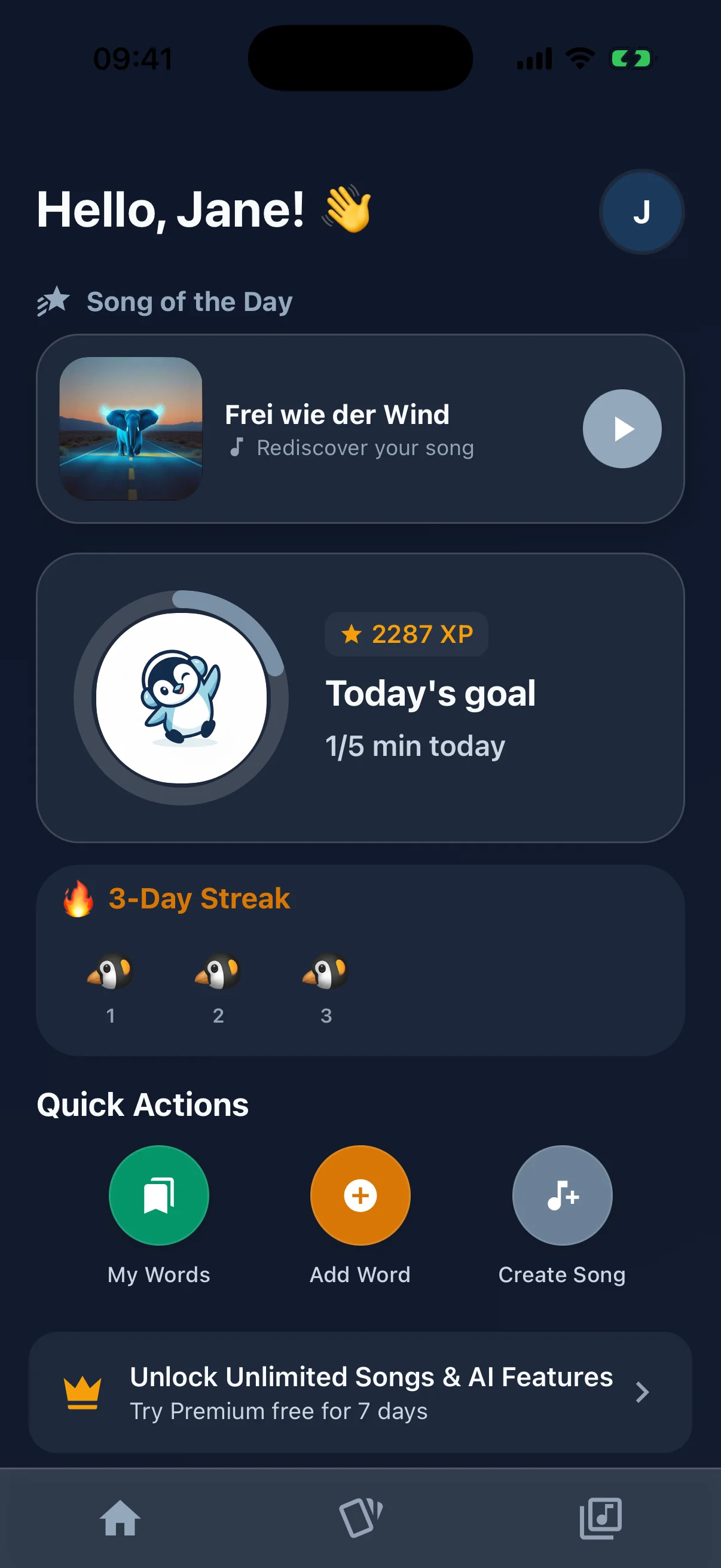
Your first song is a gift, then two custom songs a month are free, plus up to two more for watching an ad. Premium is $5.99 a month with a seven day trial. Keep the playlist running either way. Aux Champs-Élysées is a genuinely great song.
Questions people ask
What is the easiest French song for a complete beginner?
Je te laisserai des mots by Patrick Watson. It has one real verse, a total vocabulary of roughly twenty words, and Watson sings it slowly enough that every syllable is separable. Aux Champs-Élysées by Joe Dassin is a close second, because its chorus repeats il y a tout ce que vous voulez, a phrase you will reuse constantly.
Can you learn French from songs alone?
No. Songs are excellent for pronunciation, for hearing where words end, and for passive vocabulary, and they hand you repetitions you never scheduled. They will not teach verb conjugation systematically, they repeat only the words the songwriter happened to pick, and recognizing a word in a chorus is a different skill from producing it in conversation. Use songs alongside a course, not instead of one.
How many times should I listen to a French song before moving on?
Roughly three focused passes, then leave it in your normal rotation. Play it once with no lyrics, once reading the French lyrics rather than the translation, and once singing along. After that, look up only the words you kept hearing and could not identify, and let the song keep replaying in the background for weeks.