The best German songs for beginners, and what each one teaches
Start with Das Fliegerlied, 99 Luftballons and Marmor, Stein und Eisen bricht. Then Rammstein, which sounds like a joke until you hear the enunciation.
Those four take a beginner further than most graded listening material, and every song below is already used by teachers. The Goethe-Institut publishes worksheets for three of them. One turns up in American college textbooks. I spread the picks over sixty years and eight genres, because if you hate Schlager you will never press play twice.
Each entry names the words the song drills.
| Song | Artist | Level | Why it works |
|---|---|---|---|
| Das Fliegerlied | Tim Toupet (2009) | A1 | Movement verbs, repeated three times each |
| Sonne | Rammstein (2001) | A1 | Counts one to nine, brutal clarity |
| 99 Luftballons | Nena (1983) | A1 to A2 | Opens with a question and its answer |
| Marmor, Stein und Eisen bricht | Drafi Deutscher (1965) | A1 to A2 | Chorus repeats until resistance is pointless |
| Millionär | Die Prinzen (1991) | A2 | The subjunctive as Germans really say it |
| Ein Kompliment | Sportfreunde Stiller (2002) | A2 | A dass-clause slow enough to hear the verb land |
| Lieblingsmensch | Namika (2015) | A2 | Compound nouns you can take apart |
| Tage wie diese | Die Toten Hosen (2012) | A2 | One demonstrative, two cases |
| Atemlos durch die Nacht | Helene Fischer (2013) | A2 to B1 | Fast, but the diction is surgical |
| Über den Wolken | Reinhard Mey (1974) | A2 chorus, B1 verses | The clearest German on the list |
What makes a German song beginner-friendly?
Four things, and being a great song is not one of them.
- Syllables per second. Under about four and you can hear word boundaries. Above it you hear one long noise.
- A chorus that returns unchanged. The repeated melody does the memory work. A verse you hear once does almost nothing.
- A singer who closes consonants. German endings carry the grammar. Swallow the -en and the case goes with it.
- Ordinary vocabulary. Rain, money, days, sleep.
Which is why Herbert Grönemeyer, one of the best German songwriters alive, makes a terrible starting point. He mumbles gorgeously. Same with most German rap, four syllables a beat. Save both for B2.
The ten songs
1. Das Fliegerlied (So ein schöner Tag), Tim Toupet
A carnival singalong with hand gestures, written by Donikkl and taken top ten by Toupet in 2009. Aimed at children and drunk adults, which is exactly why it works. Almost all of it is first person present tense verbs, three times each: ich flieg, ich spring, ich schwimm. Plus stark (strong), groß (big), schnell (fast). Nobody will respect you for learning German this way. You will still know the words.
2. Sonne, Rammstein
The most useful three seconds on this list: it opens by counting eins through neun out loud. Till Lindemann enunciates like a man dictating his address over a bad phone line, which is a gift whatever you think of the band. You also get die Sonne, das Licht, warten (to wait) and the inverted Hier kommt die Sonne, sung four hundred times.
3. 99 Luftballons, Nena
The song non-Germans are most likely to recognize, out of the early-eighties Neue Deutsche Welle. The first two lines are the gift: Hast du etwas Zeit für mich? Dann singe ich ein Lied für dich. A yes-no question and its answer, both A1. Then Zeit, Lied, Krieg (war) and Held (hero) once the balloons start a war. The title teaches the German number habit too: neunundneunzig, ones digit first.
4. Marmor, Stein und Eisen bricht, Drafi Deutscher
Sixties Schlager, number one for five weeks in 1965, with a chorus that repeats until you are humming it. The teaching line is Weine nicht, wenn der Regen fällt: an imperative plus a subordinate clause with the verb shoved to the end, the shape textbooks spend a chapter making dull. Concrete nouns throughout: Stein, Eisen, Regen, Liebe.
5. Millionär, Die Prinzen
Satirical pop from Leipzig, 1991, sung by ex-Thomanerchor choirboys, so the harmonies are absurd. The Goethe-Institut runs it in Step into German and it appears in US college textbooks. The hook, Ich wär so gerne Millionär, hands you the subjunctive wäre in the contracted form Germans genuinely use, years before your course book admits it exists. Around it: Geld, Konto, leer (empty).
6. Ein Kompliment, Sportfreunde Stiller
Two guitars and a man being sincere, 2002, slowest track here. The chorus is one full sentence at conversational speed: Ich wollte dir nur mal eben sagen, dass du das Größte für mich bist. A dass-clause slow enough that you hear the verb bist land last, the thing every learner has to stop fighting. Also sagen, Kompliment, and the dative dir sitting where it belongs.
7. Lieblingsmensch, Namika
Mid tempo pop from 2015 about a best friend. Namika came up rapping, so her consonants land. This is the compound noun song: Lieblingsmensch is Lieblings- (favorite) plus Mensch (person), Riesenkompliment is Riesen- (giant) plus Kompliment. Learn the trick once and Lieblingsessen and Lieblingslied come free. The chorus also hands you Schön, dass wir uns kennen.
8. Tage wie diese, Die Toten Hosen
A punk band writing a stadium chorus, 2012, one of only two Toten Hosen singles to top the chart. The Goethe-Institut publishes the lyrics with A1 and B1 worksheets. The chorus runs one demonstrative through two cases seconds apart: Tage wie diese, then an Tagen wie diesen. Watch the -n in the dative plural. A grammar drill disguised as forty thousand people shouting.
9. Atemlos durch die Nacht, Helene Fischer
The biggest German-language hit of the last twenty years, and fast enough to break my own syllable rule. It earns the exception because Fischer's diction is surgical and the chorus is short. Start there and skip the verses. You get atemlos (breathless), die Nacht, spüren (to feel), and Glücksgefühle, obvious the moment you split it in two.
10. Über den Wolken, Reinhard Mey
A 1974 chanson about watching a plane leave a small airfield, and the clearest German you will hear from anyone. The refrain, Über den Wolken muss die Freiheit wohl grenzenlos sein, is a line Germans quote without thinking. From it: Wolken, Freiheit, Ängste (fears), Sorgen (worries). Be honest about the verses, though. They are long, nested and solidly B1.
Which one should you actually start with?
Never studied German: Das Fliegerlied and Sonne. Near-zero vocabulary, and both give you something to say out loud on day one. Three months in: Ein Kompliment and Millionär, where the grammar starts doing work. Leave Über den Wolken and the Atemlos verses until you can read a menu.
The method is boring and takes eight minutes. Play the song once cold and catch nothing. Play it again with the German lyrics open, not the English. Third pass, sing along badly. Then look up only the five or six words you kept hearing and could not place, and feed those into whatever review system you use. More on making them stick in how to memorize vocabulary fast, the research behind the melody in why music makes vocabulary stick, and the whole approach in our guide to learning German with music.
Where a playlist runs out
Here is the part most listicles skip.
These ten songs teach you their own words. Nena wrote about balloons and a war. Drafi Deutscher wrote about marble and iron. Neither one contains chapter four of your textbook, or the twelve verbs you keep failing, or the vocabulary for your appointment at the Ausländerbehörde on Tuesday.
So a playlist buys you recognition. Word boundaries appear, a hundred common items stick, your ear stops panicking. That is real progress. But recognition is not recall, and the gap between the two is where learners stall for months.
Recall comes from repeating your list. The awkward ones. The ones that keep coming back wrong.
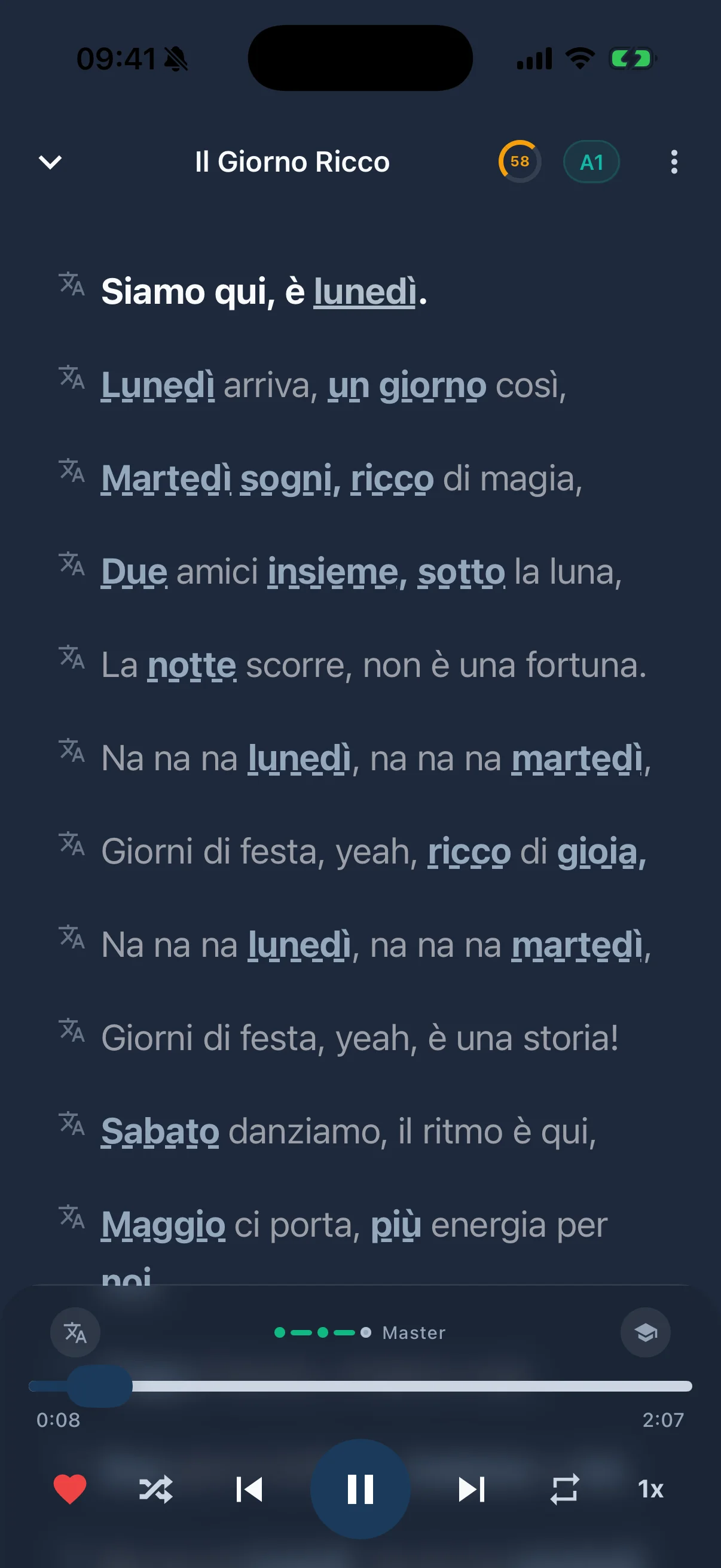
We built Lingotify to run on your list instead of a songwriter's. You paste in your own words and it writes and records a real song from them, with your worst words placed in the chorus where the repetition is heaviest. Karaoke lights each word as it is sung, quizzes appear inside the track, and every answer feeds an SM-2 spaced repetition schedule. Six languages, German included.
Make a song from your own words
Your first song is a gift, then two custom songs a month are free, plus up to two more for watching an ad. Premium is $5.99 a month with a seven day trial. Keep the playlist running either way. Marmor, Stein und Eisen bricht is a genuinely great song.
Questions people ask
What is the easiest German song for a complete beginner?
Das Fliegerlied by Tim Toupet. It is built almost entirely from first person present tense verbs like ich flieg and ich spring, each repeated three times, at a tempo slow enough to separate every word. Rammstein's Sonne is a close second because it counts from eins to neun out loud with unusually clear enunciation.
Can you learn German from songs alone?
No. Songs are excellent for pronunciation, word boundaries and passive vocabulary, and they hand you repetitions you never scheduled. They will not teach case endings systematically, they repeat only the words the songwriter happened to pick, and recognizing a word in a chorus is not the same skill as producing it in conversation. Use songs alongside a course, not instead of one.
How many times should I listen to a German song before moving on?
Roughly three focused passes, then leave it in your normal rotation. Play it once with no lyrics, once reading the German lyrics, and once singing along. After that, look up only the words you kept hearing and could not identify, and let the song keep replaying in the background for weeks.