The best Spanish songs for beginners, and what each one teaches
Start with La Bamba, Me gustas tú and Vivir Mi Vida. Then Bonito, which is so slow and so repetitive that you will accidentally memorize it.
Those four carry a beginner further than most graded listening material, and every song below already lives in real classrooms. La Bamba turns up in Spanish 1 with the blanks over bailar and soy. I spread the picks across seven decades and two continents, because Spanish belongs to twenty countries and handing you ten reggaeton tracks would be lying.
Every entry names the words the song drills. The level calls are mine, based on how much of a song a learner can actually follow, not on how famous it is.
| Song | Artist | Level | Why it works |
|---|---|---|---|
| La Bamba | Ritchie Valens (1958) | A1 | Six lines, sung eight times, all present tense |
| Me gustas tú | Manu Chao (2001) | A1 | The verb gustar, drilled forty times |
| Bonito | Jarabe de Palo (2003) | A1 | One adjective, one structure, endless repetition |
| Guantanamera | Cuban standard, Martí verses | A1 to A2 | Yo soy, in the plainest sentence in Spanish |
| Vivir Mi Vida | Marc Anthony (2013) | A1 to A2 | The near future tense, shouted |
| Color Esperanza | Diego Torres (2001) | A2 | Torres over-enunciates and it helps |
| Limón y Sal | Julieta Venegas (2006) | A2 | Stem-changing verbs at walking pace |
| Bailando | Enrique Iglesias (2014) | A2 | Gerunds, four in a row, unmissable |
| Rosas | La Oreja de Van Gogh (2003) | A2 | Slowest diction on this list |
| A Dios le pido | Juanes (2002) | A2 chorus, B1 verses | Your first honest subjunctive |
What makes a Spanish song beginner-friendly?
Four things, and being a good song is not one of them.
- Tempo you can hear inside. Roughly under 110 beats per minute, and the words separate. Above that, Spanish turns into one continuous vowel.
- A chorus that comes back unchanged. Repetition is the whole trick. A verse you hear once teaches almost nothing.
- Consonants that survive. Caribbean Spanish eats final S sounds and swallows D between vowels. Beautiful to listen to, brutal to transcribe at month one.
- Everyday nouns. Sea, life, morning, mouth, dance.
Which is why so much of the best Spanish music makes a terrible first lesson. Silvio Rodríguez writes like a poet. Bad Bunny is Puerto Rican slang at speed. Enjoy both now anyway, just do not expect them to teach you anything yet.
The ten songs
1. La Bamba, Ritchie Valens
A Mexican son jarocho wedding song that a seventeen year old from California turned into rock and roll in 1958. The whole lyric runs about six lines and then loops. You get para bailar la bamba (in order to dance the bamba), se necesita (one needs), un poco de gracia, and the line Spanish 1 teachers love, yo no soy marinero, soy capitán. That one line hands you ser in the first person, positive and negative. Sixty-eight years old and still the cheapest vocabulary going.
2. Me gustas tú, Manu Chao
From Próxima Estación: Esperanza in 2001, and it is a list. Manu Chao names things he likes for four minutes: me gustan los aviones, me gusta viajar, me gusta la mañana. Then the hook flips to a person and the verb changes shape: me gustas tú. Learners fight gustar for months because it runs backwards from English. This song settles it by brute force, which is why half the gustar worksheets online carry Manu Chao's name.
3. Bonito, Jarabe de Palo
Pau Donés from Barcelona, 2003, the gentlest song here. The title adjective repeats until you cannot lose it, wrapped in a structure you will use daily: todo me parece bonito. That single line gives you parecer (to seem), todo, and the indirect object me doing exactly what it did for Manu Chao. Also la vida and el mar. Donés died in 2020 and Spain still plays this constantly.
4. Guantanamera, Cuban standard
Melody by Joseíto Fernández, verses lifted from José Martí's Versos Sencillos, recorded by everyone from Pete Seeger to Celia Cruz. Pick a slow version. The opening may be the plainest sentence in the language: yo soy un hombre sincero, de donde crece la palma. There is ser again, plus hombre, crecer (to grow), palma and alma. Martí was writing poetry, so the later verses drift, but those first eight lines are worth a week.
5. Vivir Mi Vida, Marc Anthony
Salsa from 2013, adapted from Khaled's C'est la vie, and the most efficient grammar lesson here. The chorus stacks the near future: voy a reír, voy a bailar, vivir mi vida. Once you hear voy a plus an infinitive at that volume, you own the construction. Around it sit reír, llorar and la vida. Teachers hand this out as a fill-in-the-blank sheet at novice level, and it works because the words land on the beat.
6. Color Esperanza, Diego Torres
Argentine pop from 2001, and Torres sings like a man who suspects you are taking notes. Every syllable arrives whole. The song is about hope, so the vocabulary runs abstract, but it is the useful kind: saber que se puede, creer, cambiar, esperanza. Stop on se puede. It turns up on street signs and in arguments across the whole Spanish-speaking world.
7. Limón y Sal, Julieta Venegas
Mexico, 2006, accordion and a woman singing about accepting somebody exactly as they are. The pace is a walk. The chorus gives you yo te quiero con limón y sal and yo te quiero tal como estás, a whole relationship philosophy and also a clean contrast between querer and estar. Teachers use it for stem-changing verbs, since querer shifts its vowel right where you can hear it.
8. Bailando, Enrique Iglesias
The 2014 monster with Descemer Bueno and Gente de Zona, flamenco guitar bolted to a Cuban chorus. The gerund is the lesson. Bailando, then tu cuerpo y el mío llenando el vacío, then subiendo y bajando. Four -ando endings in a handful of seconds, which is how the present progressive should be taught and never is. You also collect el cuerpo and el corazón. The verses run faster than my own tempo rule allows, so treat the chorus as the lesson.
9. Rosas, La Oreja de Van Gogh
Pop from San Sebastián, 2003, and Amaia Montero's diction is the slowest and clearest here, which is why Spanish schools recommend it constantly. It teaches feelings and time rather than objects: rosas, esquina, sonrisa, cada día. The line worth memorizing is el amor verdadero es tan sólo el primero. Melancholy, but every learner I know finishes it feeling capable.
10. A Dios le pido, Juanes
Colombian rock from 2002, and the one place I would let a beginner meet the subjunctive early. The song is built on a Dios le pido que, followed by verb after verb in a mood your textbook postpones until chapter twelve: que mis ojos se despierten, que mi madre no se muera. You do not need to parse it. Hear the pattern enough and the eventual grammar lesson becomes a name for something you already know. Vocabulary: pedir, los ojos, el alma. The verses move fast, so I put them at B1 honestly.
Which one should you actually start with?
Never studied Spanish: La Bamba and Me gustas tú. Almost no vocabulary required, and both give you something to sing out loud on the first day, badly, in the car. Three months in: Vivir Mi Vida and Limón y Sal, where the grammar starts pulling its weight. Leave the A Dios le pido verses and the fast half of Bailando until you can order lunch without rehearsing.
The method takes eight minutes and it is dull, which is why it works. Play the song once cold and catch nothing. Play it again with the Spanish lyrics open, never the English. Third pass, sing along and mangle it. Then look up only the five or six words you kept hearing and could not place, and put those into whatever review system you already trust. The science behind the melody is in why music makes vocabulary stick, the realistic timeline in how long it takes to learn Spanish, and the full method in our guide to learning Spanish with songs. The German list follows the same rules if you are running two languages at once.
Where a playlist runs out
Here is the part the other lists leave out.
These ten songs teach their own words. Manu Chao likes airplanes. Martí wrote about palm trees. Julieta Venegas wrote about lemons. None of them contains chapter four of your textbook, or the eleven verbs you keep getting wrong, or the vocabulary for your appointment at the clinic on Thursday.
A playlist buys you recognition. Word boundaries appear, your ear stops panicking, a couple hundred common items settle in. That is genuine progress and I would never talk anyone out of it. But recognition is not recall, and the space between those two is where most learners sit for a year without noticing.
Recall comes from repeating your list. The awkward words. The ones that keep coming back wrong.
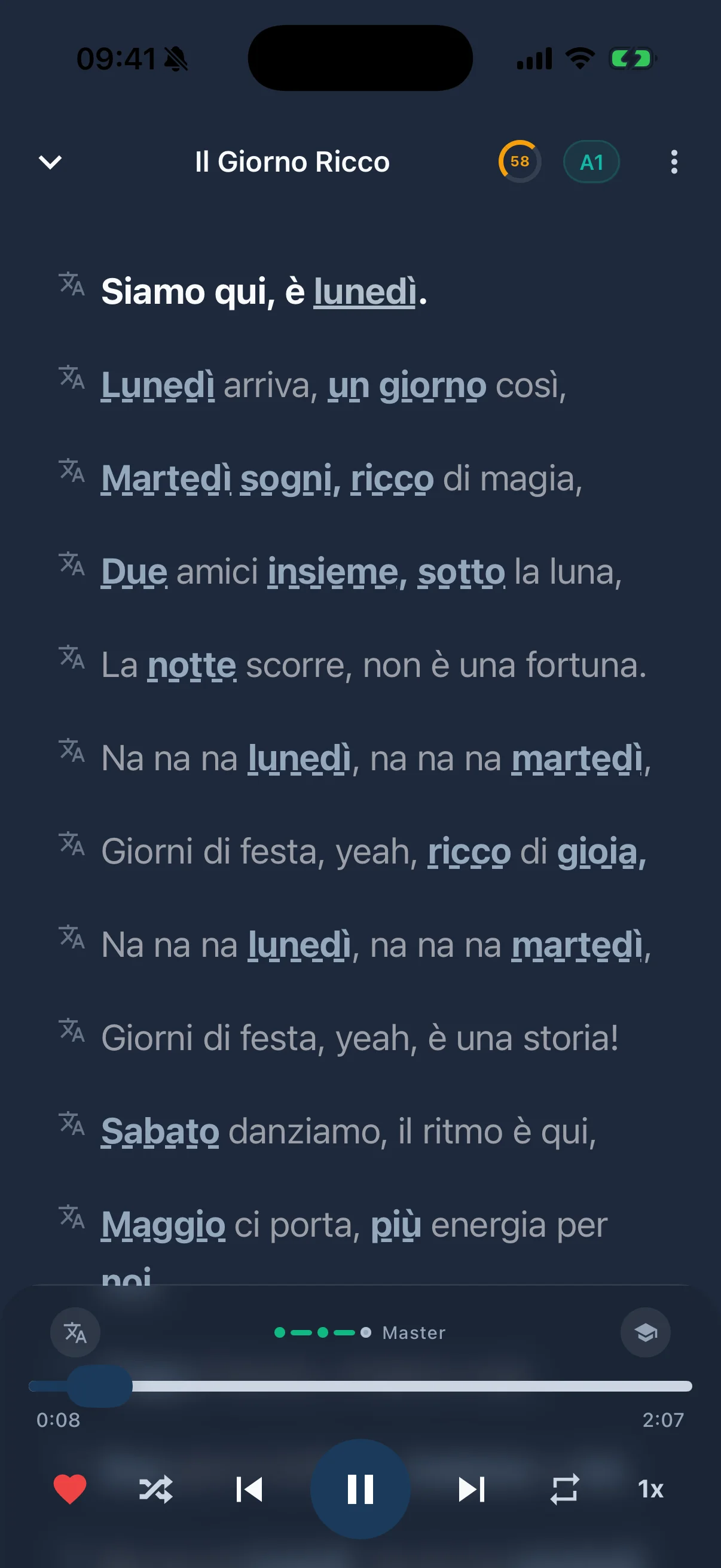
Lingotify runs on your list instead of a songwriter's. You put your own words in and it writes and records a real song from them, with the words you keep missing placed in the chorus where the repetition is heaviest. Karaoke lights each word as it is sung, quizzes appear inside the track, and every answer feeds an SM-2 spaced repetition schedule. Six languages, Spanish included.
Make a song from your own words
Your first song is a gift, then two custom songs a month are free, plus up to two more for watching an ad. Premium is $5.99 a month with a seven day trial. Keep the playlist going regardless. Bonito is a lovely song and it deserves better than being homework.
Questions people ask
What is the easiest Spanish song for a complete beginner?
La Bamba by Ritchie Valens. The entire lyric is about six lines long and it repeats, the tempo is slow enough to separate every word, and the line yo no soy marinero, soy capitán teaches the verb ser in positive and negative form in under three seconds. Me gustas tú by Manu Chao is a close second because it repeats the verb gustar dozens of times in a single track.
Can you learn Spanish from songs alone?
No. Songs are excellent for pronunciation, word boundaries and passive vocabulary, and they hand you repetitions you never had to schedule. They will not teach you verb conjugation systematically, they only repeat the words the songwriter happened to choose, and recognizing a word in a chorus is a different skill from producing it in conversation. Use songs alongside a course, not instead of one.
Should beginners avoid reggaeton when learning Spanish?
Not entirely, but choose carefully. Reggaeton and Caribbean pop often drop final S sounds and soften D between vowels, which makes the audio hard to match against written Spanish in your first months. Chorus-heavy tracks like Bailando still work well because the hook is slow and repeated. Save fast verse-driven reggaeton for the point where you can already follow clearer singers.