A Duolingo alternative for music lovers
If you learn half a chorus before you learn a single conjugation, the app that fits you is not the one with the most languages. It is the one that builds a song out of your own words.
This page is for a specific person. You keep a playlist in the language you are learning. You can sing along to parts of it without being able to translate most of it. Vocabulary lists bore you into quitting by week two, and yet a hook you heard once at a party is still sitting in your head four years later. Duolingo is a serious app, and it does several things better than we do, starting with the one that matters most early on: it gets you to show up. What it does not do is take the words you personally keep forgetting and build a song around them. That is all Lingotify does. You choose the words, it writes and records a track that uses them, then teaches from that track with word-by-word karaoke, quizzes on the line you just heard, and an SM-2 review schedule running underneath. Six languages instead of more than forty. One medium instead of a full curriculum. Duolingo builds streaks. Anki builds decks. Lingotify builds songs from your words.
If you are starting from zero, want a grammar path, or are learning Navajo, Duolingo is the better first move and it costs nothing. Come back once you have a pile of words that refuse to stick.
What Duolingo gets right
Being fair about this is not politeness. It is the only reason to trust the rest of the page.
The streak works. Not because a number is motivating by itself, but because it turns a vague intention into a two minute daily action with a visible cost for skipping. Most language apps die at the point where the learner stops opening them, and Duolingo has spent a decade engineering against that.
The breadth is real. More than forty languages, including ones almost nobody else supports, plus non-language subjects like music and chess, across hundreds of free courses. The free tier is usable, not a demo. It is ad-supported, with limits a subscription removes, but nobody is locked out of the course path for refusing to pay. For a lot of learners that is simply the correct answer, and no blog post should talk them out of it.
The gap, stated precisely
Duolingo does have a Music course, worth naming because the title of this page collides with it. It teaches music theory on an on-screen keyboard: pitch, rhythm, note reading, and playing pieces, including public domain songs and licensed recordings. It teaches music. It does not teach Spanish through songs.
Inside the language courses, audio is a testing surface. You hear a sentence and you type it back or tap the words into order. That works. It is not what a song does. A song fixes a phrase into a melody, a rhythm, and a set number of syllables, then returns on its own three hours later while you are washing dishes. The research on why that helps has a catch in it, and we covered the catch separately in why music makes vocabulary stick.
The second half of the gap is whose words they are. A Duolingo course teaches its own vocabulary in its own order, which is correct design for a course and wrong for the twelve words that are personally beating you. Your list does not look like mine. It contains the noun whose gender refuses to stay put and the phrase a coworker used last Tuesday that you nodded at without understanding.
Side by side
Some rows go to Duolingo. A comparison table that wins every line is an advertisement, not a comparison.
| Duolingo | Lingotify | |
|---|---|---|
| Languages taught | More than 40 | 6: German, Spanish, French, Italian, Turkish, English |
| Course structure | A full path from beginner upward, with grammar and speaking | None. It works on words you bring to it |
| Songs built from your own word list | Not offered | The core feature, across 18 genres |
| Word-by-word karaoke in your target language | Not offered | Yes, with tap-to-translate on any word |
| Quizzes on the lyric line you just heard | Not offered | Yes, mid-song |
| Spaced repetition | Yes, using its own published scheduling model | Yes, SM-2 |
| Free tier | Ad-supported and broad; the course path stays open | First song a gift, then two custom songs a month, plus up to two more by watching an ad |
| Best at | Getting you to practice every day for a year | Making one stubborn word stop being stubborn |
Two rows need a footnote. Spaced repetition is not a point of difference here, and anyone selling it as one is bluffing: Duolingo published its own trainable spaced repetition model in 2016 and personalizes review with it. Ours is SM-2, the algorithm Anki users know, pointed at the words inside your songs. On the free tier, theirs is plainly broader. Two custom songs a month is enough to test this on your memory, not enough to run a semester on.
What a week of this looks like
Say you are learning German and five words have been beating you for a month.
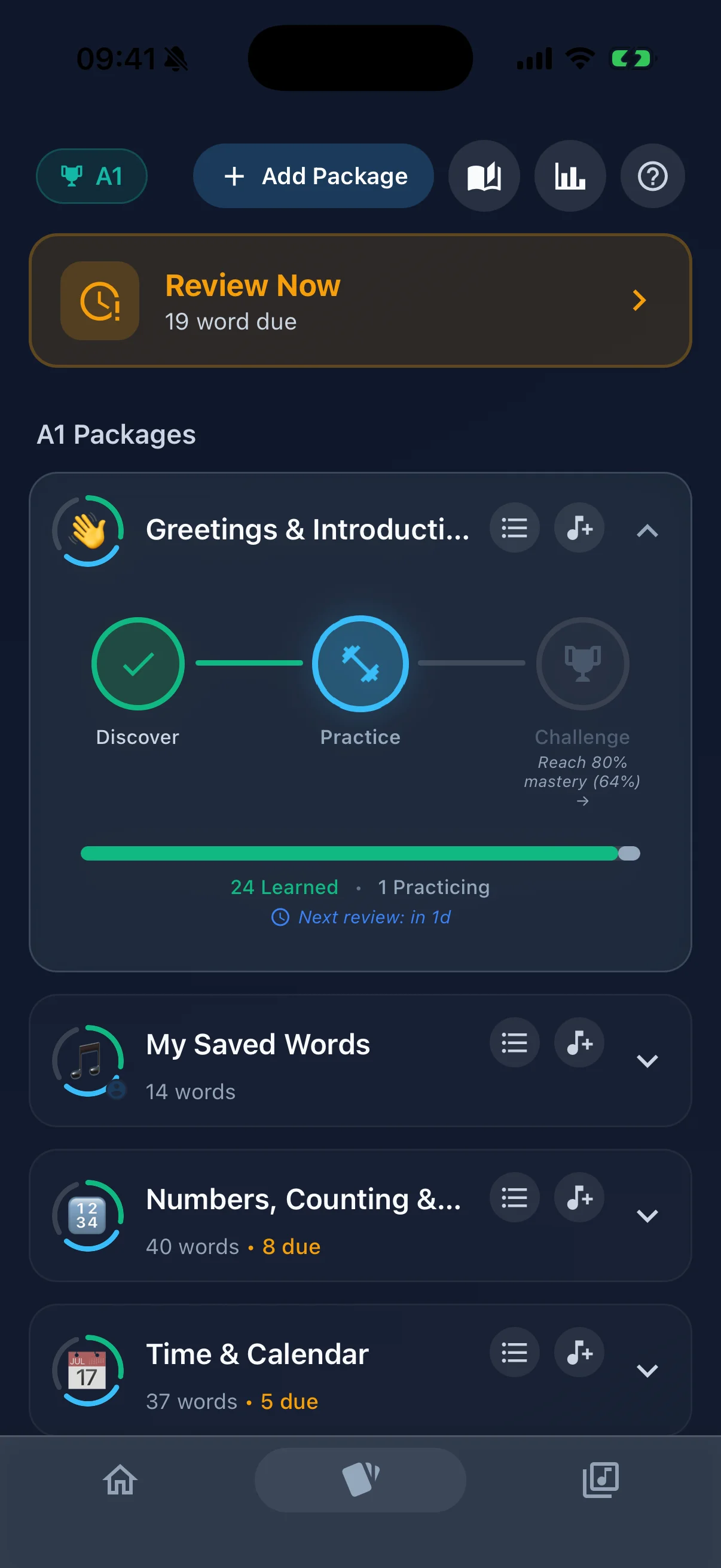
- You choose the words and a genre. Five to ten words per song works best, across eighteen genres.
- It writes the lyrics, then records them. A minute or two of waiting. The hard words go into the chorus, because the chorus is the part that repeats.
- You listen with karaoke running. Each word lights up as it is sung, so sound and spelling arrive together. Tap any word for its meaning.
- The song quizzes you mid-listen. A word gets blanked out of the line you just heard and you fill it back in, which turns a listening pass into a recall test.
- Every answer feeds the schedule. Right answers push a word further out. Wrong ones bring it back tomorrow.
Then comes the part no app controls. The hook shows up in your head on the bus, carrying your words. That is the entire pitch.
Where this will annoy you
Six languages is six languages. If you are learning Japanese or Polish, we are no use to you yet.
There is no grammar syllabus either. Lingotify assumes something else is teaching you how the language is put together, and for a true beginner Duolingo fills that hole better.
The songs are AI generated. They land often enough to do the job and they will not become your favorite record. If a machine-made track bothers you on principle, that is a fair objection.
Recognizing a word when the chorus hands it to you is also not the same skill as producing it in conversation. The in-song quizzes exist because of that exact gap. They narrow it. They do not close it.
Run both, if you want
These tools are not competing for the same slot in your day. Duolingo owns the daily habit and the structured path through a language. Lingotify owns the words that will not stay put, using the medium your brain already replays for free. Plenty of people run one in the morning and the other on the walk home.
If music is how things stick for you, the right move is to test it on five words rather than read more about it. For one language in depth, there are longer guides on learning German with music and learning Spanish with songs, and the evidence question is handled in do songs help you learn a language.
Your first song is a gift, and free covers two custom songs a month after that, plus up to two more if you watch an ad. Premium is $5.99 a month or $47.99 a year with a seven day trial, and raises the limit to fifteen songs a month.
Questions people ask
Is Lingotify a replacement for Duolingo?
Not really. Duolingo is a course with a habit engine wrapped around it. Lingotify is a memory tool for words you already know you need. If you are starting a language from zero, start on Duolingo and add songs once you have collected a list of words that keep escaping you.
Which languages does Lingotify support?
German, Spanish, French, Italian, Turkish, and English, both as the language you are learning and as the language the app explains things in. That is far fewer than Duolingo's forty plus, and it is the honest cost of generating and timing real songs in each one.
Can I try it without paying?
Yes. Your first song is a gift, then two custom songs a month are free, and you can earn up to two more by watching a rewarded video. Premium is $5.99 a month or $47.99 a year with a seven day trial. The free songs are enough to answer the only question that matters here, which is whether a chorus made of your own words stays in your head.